

Uber Eats & DoorDash Tips in 2026: NYC Court Ruling, $550M Tip Loss & What Drivers Need to Know
If you deliver for Uber Eats or DoorDash, 2026 has been a rollercoaster year for your tips. Back in January, a bombshell report revealed that delivery drivers lost over $550 million in tips because of how these apps quietly rearranged their tipping screens. Then a federal court stepped in and forced the apps to put tips back where customers can actually see them at checkout.
This isn’t just a New York City story — it affects every gig worker who counts on tips to make ends meet. Here’s exactly what happened, what it means for your wallet, and how to protect your earnings going forward.
The $550 Million Problem: How DoorDash and Uber Eats Changed Tipping
Here’s what actually happened. Before December 2023, both Uber Eats and DoorDash showed customers the tipping option during checkout — right before they confirmed their order. It was right there on the screen. Customers tipped because they saw it.
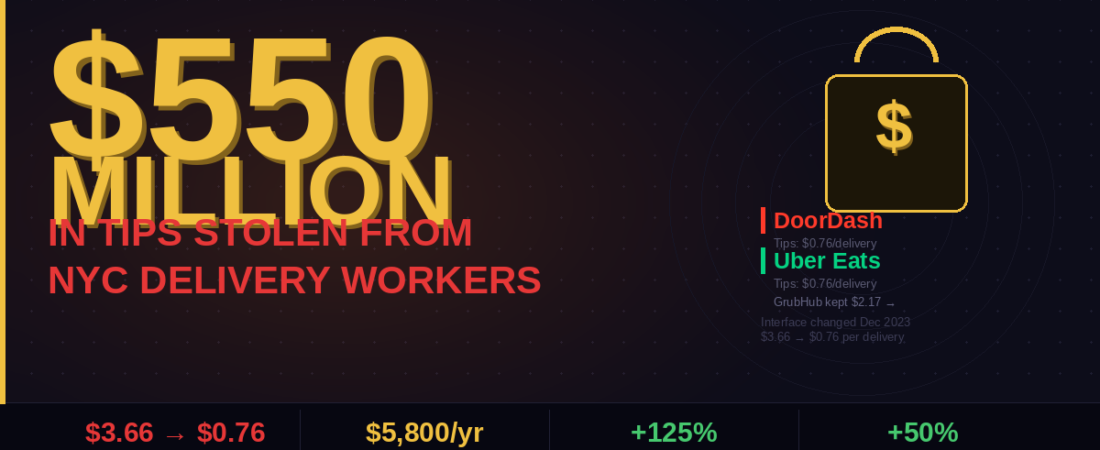
Then both apps quietly moved the tipping prompt to after the order was placed. Out of sight, out of mind. The result was a massive drop in tips for delivery workers. According to a January 2026 report from the NYC Department of Consumer and Worker Protection (DCWP), that single change cost delivery drivers a staggering $554 million in lost tips between December 2023 and mid-2025.
That works out to $5,800 per year per driver — money that real people needed for rent, groceries, and gas.
What the NYC Court Ruled About Tipping
On January 23, 2026, U.S. District Judge George Daniels rejected a joint lawsuit from DoorDash and Uber Eats that tried to block New York City’s new tipping regulations. The apps argued that forcing them to show tip prompts at checkout violated their First Amendment rights (claiming it compelled them to “speak” about tipping) and would worsen customer “tipping fatigue.”
Judge Daniels didn’t buy it. His 13-page ruling stated that the new rules “advance the city’s goals of enhancing cost transparency at the time of checkout, restoring consumer choice, and providing protections to delivery workers.”
He also shot down the “tipping fatigue” argument, pointing out that tipping delivery workers isn’t exactly a new concept in America.
The New Tipping Rules: What Changed
Starting January 26, 2026, food delivery apps operating in New York City must:
- Show the tipping option at checkout — not after the order is placed
- Set a minimum default tip of 10% (customers can change it)
- Make the tipping prompt clear and prominent
This applies to Uber Eats, DoorDash, and Instacart (which filed a separate but similar lawsuit that a different federal judge also rejected).
How Much Money Did Drivers Actually Lose?
The numbers are hard to ignore. According to the NYC DCWP report:
- Total tips lost: $554 million across Uber Eats and DoorDash deliveries
- Per-driver impact: ~$5,800 per year
- Tip rate dropped: From customers tipping on most orders to tipping on far fewer
Average Tips Per Order: From $1.56 to $0.76
Before the change, the average tip on DoorDash and Uber Eats orders was $1.56 per order. After both apps moved the tipping prompt to after checkout, that average dropped to just $0.76 per order — a 51% decrease.
Do the math. If you’re knocking out 20 deliveries in a shift, you’re losing roughly $16 per shift in tips alone. Spread that over a 5-day work week and you’re down $320 per month. That’s real money.
DoorDash Minimum Wage in NYC: $21.44/Hour
Separate from the tipping fight, NYC also put in place a minimum wage for app-based delivery workers. As of 2026, companies like DoorDash and Uber Eats must pay drivers at least $21.44 per hour before tips for time spent on deliveries.
This minimum wage law survived a multi-year legal battle. DoorDash and Uber Eats both warned they’d have to raise fees or overhaul their business models — but the courts held firm, and NYC delivery drivers now have a legal earnings floor.
What this means in practice: your base pay + tips should put you in a significantly stronger spot than before. With front-end tipping back in place, drivers in NYC could see their effective hourly rate climb toward $25-$30/hour.
For a real-world breakdown, check out: How I Made $6,000 in One Month on DoorDash & Uber Eats.
How This Affects Drivers Outside NYC
You might be thinking, “I don’t deliver in NYC — so why does this matter to me?”
It does. Here’s why:
- Precedent-setting: NYC is usually first to pass gig worker protections. San Francisco, Seattle, Chicago, and Los Angeles are all watching how this plays out.
- App-wide changes: When DoorDash and Uber Eats update their tipping interface for one market, they sometimes roll it out globally. Drivers in other states have already noticed changes to tip prompts since the ruling.
- Awareness matters: The more customers hear about tipping, the more likely they are to tip — no matter where you deliver.
- Class-action momentum: DoorDash already settled a class-action lawsuit over its “tipping model.” Driver advocacy is gaining real legal traction across the country.
5 Ways to Maximize Your Earnings as a Delivery Driver in 2026
1. Multi-App Strategically
Don’t depend on a single platform. Run DoorDash, Uber Eats, and Grubhub simultaneously, accept the best-paying offers, and pause the rest. Multi-apping alone can push your hourly rate up by 30-50%. See it in action: How I Made $6,000 in One Month on DoorDash & Uber Eats.
2. Track Every Mile for Tax Deductions
The IRS mileage deduction for 2026 is $0.70 per mile. Drive 200 miles a week and that’s $140 per week in deductions — which can save you $4,000+ in taxes per year. We reviewed the best tools for this: 5 Best Apps to Track Mileage for Uber Eats and DoorDash Drivers.
3. Work Peak Hours
The best money comes during 11 AM – 2 PM (lunch), 5 PM – 9 PM (dinner), and weekends from 10 AM – 9 PM. Peak hours mean bigger orders, more tips, and customers who actually care about fast delivery.
4. Save the Right Amount for Taxes
As a 1099 independent contractor, you’re on the hook for self-employment tax (15.3%) + income tax. Put 25-30% of every payout into a separate account before you touch it. Read our 1099 vs W-2 Tax Guide and use our tax savings formula to see the full breakdown.
5. Stack AI Training Tasks Between Deliveries
DoorDash now pays drivers to train AI through their “Tasks” program. Slow stretch between orders? Take some photos, record a few videos, get paid. Learn how DoorDash and Uber pay gig workers to train AI.
The Bottom Line: What Gig Workers Should Do Now
The NYC tipping ruling is a real win for delivery drivers. It shows that when gig workers push back, things actually change. But you can’t sit around waiting for courts to protect your income.
Your action plan for 2026:
- Track your tips — Know what you’re earning per order. If tips start slipping, switch apps.
- Multi-app — Don’t put all your eggs in one basket.
- Maximize deductions — Mileage is your biggest tax saver. See The Complete Tax Guide for Gig Workers.
- Save for taxes quarterly — Don’t get blindsided in April. Make estimated payments.
- Stack delivery with AI tasks — Turn dead time into paid time.
Frequently Asked Questions
Did DoorDash and Uber Eats actually steal $550 million in tips?
The NYC DCWP found that moving the tipping prompt to after checkout resulted in $554 million in lost tips for delivery workers. Whether you call it stealing or not, drivers took a massive hit either way.
Does the new NYC tipping law apply to all delivery apps?
Yes. The rules cover all third-party food delivery services in NYC, including Uber Eats, DoorDash, Grubhub, and Instacart.
Will I see more tips outside NYC because of this ruling?
Possibly. Both Uber Eats and DoorDash have pushed app-wide updates before. Some drivers in other states have already noticed tip prompts appearing earlier since the NYC ruling came down.
What’s the minimum pay for delivery drivers in 2026?
In NYC, app-based delivery drivers must earn at least $21.44/hour before tips. In most other cities, there’s no minimum wage for gig workers since they’re classified as independent contractors (1099).
How should I save for taxes as a gig worker?
Pull 25-30% of each payout straight into a separate account. Then make quarterly estimated tax payments using IRS Form 1040-ES. Use our tax savings formula to nail down the exact amount.
Is multi-apping legal?
Yes, completely legal. You’re an independent contractor and you can work for as many platforms as you want. Just keep an eye on your delivery times so you’re not overcommitting.
🔥 Start Driving with Uber & Earn Big!
✅ Earn at least $2,575 for your first 188 passenger trips in 30 days.
✅ Earn at least $1,100 for your first 100 deliveries in 30 days.
🚀 Returning to Uber? Sign in to check your eligibility for a referral offer.
Terms apply. New drivers only. Bonus varies by city.