

Pull up your DoorDash or Uber Eats queue on any weekday afternoon and count the fast food offers: McDonald’s, Taco Bell, Wendy’s, Chipotle, another McDonald’s, a Burger King. Quick-service restaurant orders make up the majority of what lands in your queue every hour of every shift, and in 2026 that volume has only accelerated. The US online food delivery market hit $105.8 billion in 2026, driven largely by fast food. McDonald’s signed new delivery agreements with both DoorDash and Uber Eats simultaneously — flooding both platforms at once. DoorDash delivery orders grew 34.1% year-over-year. Uber Eats climbed 46.6%. Most of that growth is McNuggets and Crunchwrap Supremes, not Michelin-starred entrees.
For drivers, this creates a real problem. Fast food orders are the easiest offers to accept — and the easiest to lose money on. A McDonald’s pickup during the dinner rush can turn a 10-minute trip into 40 minutes if you sit in the drive-thru behind a line of actual customers. A Taco Bell at 2 PM on a Tuesday can be the fastest $9 you earn all day. Without a system for reading each chain and each pickup situation, you’re flying blind through the most common order type you’ll ever see. This guide gives you that system — chain by chain, situation by situation, daypart by daypart.
Why Fast Food Floods Your Queue in 2026
The volume math is straightforward: 60% of Americans place at least one food delivery order per week in 2026, and their most-ordered category by far is quick-service food. People order from McDonald’s on DoorDash at 2 PM on a Wednesday because it takes 30 seconds to set up and costs them $14. That behavior isn’t going away — it’s accelerating.
McDonald’s expanding to both major platforms changed the delivery landscape for drivers overnight. Previously operating with platform exclusivity in some markets, the chain now pushes orders through DoorDash and Uber Eats simultaneously. That means double the McDonald’s offers hitting your queue, more driver competition for those orders, but also more overall volume that keeps your queue full during traditionally slow windows like mid-morning and early afternoon.
Here’s the catch every experienced driver already knows: fast food tips run low. The national average customer tip across all delivery platforms is around $4.19 per order, but fast food orders consistently underperform that number. Customers ordering a $12 combo meal think 15% means they’re being generous — that’s $1.80. Full-service restaurant orders, where tickets average $30-$50, yield meaningfully higher tip dollars for the same percentage. Understanding this reality doesn’t mean you avoid fast food — it means you evaluate each offer correctly and know which chains and order sizes actually move the needle on your hourly rate.
For more context on how pay structures break down across platforms — which matters as much as the chain you’re picking up from — see this honest 2026 comparison of DoorDash vs. Uber Eats vs. Instacart pay.
Fast Food Chain Rankings: Wait Times, Tips, and Driver Verdict
Not all fast food is equal for delivery drivers. The biggest variable is pickup wait time — and a 2025 industry study measured average total drive-thru time at every major chain. These numbers translate directly into your implied hourly earnings rate on every offer you accept.
Taco Bell — Driver Grade: A
Taco Bell is the fastest major quick-service chain for pickup, averaging 4 minutes and 16 seconds in drive-thru — a record it has held for five consecutive years. The menu is assembly-friendly, most items are ready quickly, and order accuracy is generally solid. Taco Bell orders tend to run in the $15-$25 range when customers add extras and drinks, so you’re not getting rich on tip percentages, but you’re moving fast. A consistent sub-5-minute pickup window means almost any Taco Bell offer with a reasonable drive distance will clear your minimum hourly rate. This is the chain you should almost always accept.
Arby’s — Driver Grade: B+
Arby’s clocks in at 4 minutes and 32 seconds average and carries lower delivery volume than the top chains — which means less driver competition for orders and faster service when you do show up. The customer base tends to tip slightly better than burger chains, likely because average order tickets run higher. The downside is simple footprint: Arby’s doesn’t exist in every market at the density of McDonald’s or Taco Bell, so depending on where you drive, you may not see these offers frequently enough to factor them into your daily strategy.
Wendy’s — Driver Grade: B
Wendy’s averages 4 minutes and 53 seconds — still comfortably under 5 minutes — with solid delivery volume across most US markets. The chain has leaned hard into delivery partnerships, and many locations have added dedicated mobile order pickup areas inside that let you bypass the drive-thru line entirely. When you can walk in and grab a labeled bag off the shelf, Wendy’s is a clean, fast pickup. Order tickets often land in the $18-$28 range for families and groups, which generates workable tip amounts. Know your local locations and whether they have walk-in pickup — it’s the difference between a B and a B+ at any specific store.
Burger King — Driver Grade: C
Burger King averages 6 minutes and 2 seconds — nearly 90 seconds longer than Taco Bell. During off-peak hours that gap is manageable. During dinner rush, Burger King locations routinely see lines that push real wait times to 12-18 minutes. Many Burger King locations still lack a dedicated mobile pickup shelf, which forces you into the drive-thru even for a simple labeled bag. Unless the offer shows a solid visible tip and the pickup is genuinely close to where you’re already positioned, Burger King orders during peak hours frequently fail the dollars-per-hour test. Off-peak, between 2 PM and 4:30 PM, it becomes considerably more workable.
McDonald’s — Driver Grade: C+ (Actively Improving)
McDonald’s averages 6 minutes and 3 seconds in drive-thru — essentially tied with Burger King — but the chain is mid-rollout of changes in 2026 that should move it up the rankings. More on that in the next section. McDonald’s volume is massive: you will see more McDonald’s offers than from any other chain. The challenge is that McDonald’s drive-thrus are notoriously backed up during peak periods, and the designated pickup areas inside vary wildly by location. Some McDonald’s stores have a clean shelf system that gets you out in 3 minutes. Others require you to stand at a counter while your order number gets called alongside dine-in customers. Know your local stores before you set a standing policy on McDonald’s accepts.
Chick-fil-A — Driver Grade: B (Situational)
Chick-fil-A has the longest average drive-thru wait of any major QSR — routinely 8-12 minutes even at off-peak hours. The line wraps around the building regardless of when you show up. But here is the counter-argument: Chick-fil-A customers are the best tippers of any fast food chain in most markets, and average order tickets are meaningfully higher than burger chains. More importantly, many Chick-fil-A locations have installed dedicated delivery pickup lanes or interior walk-in systems that are dramatically faster than the main drive-thru. Check your specific local Chick-fil-A before deciding your default policy — if it has a functional walk-in pickup area or a dedicated delivery lane, it jumps from a situational accept to one of your most profitable fast food chains.
Drive-Thru vs. Walk-In: Reading Every Pickup Situation Right
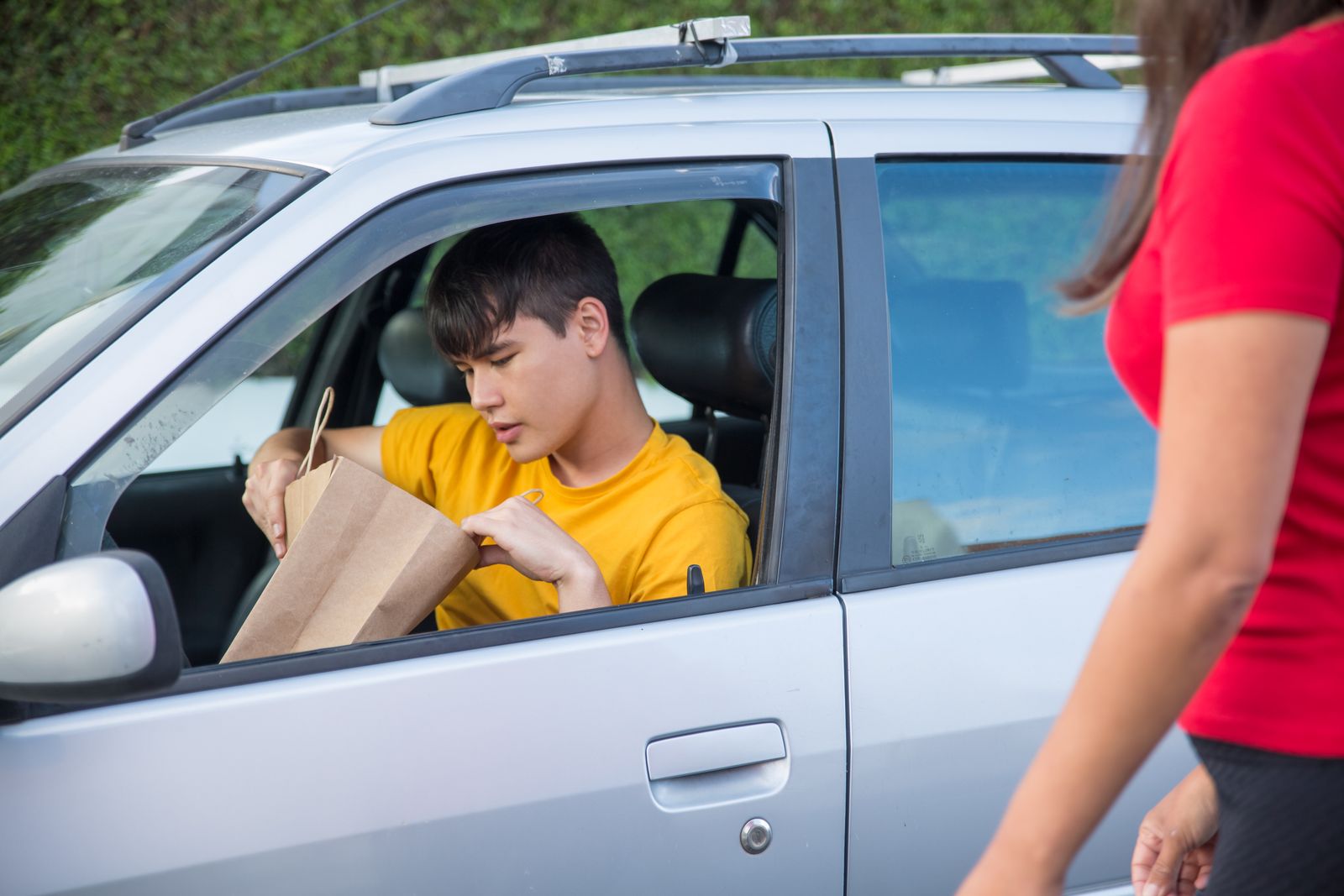
The single biggest mistake new delivery drivers make at fast food pickups is defaulting to the drive-thru. The drive-thru is designed for paying customers who are ordering fresh food and paying at the window. You are picking up an order that is already made, packaged, labeled, and sitting on a shelf somewhere inside. In 2026, the overwhelming majority of major fast food chains have mobile order pickup systems inside the restaurant — and using them is almost always faster than the drive-thru by 5 to 10 minutes.
Here’s how to read the situation before you even pull into the parking lot:
- Check the app instructions first. DoorDash and Uber Eats both include pickup instructions in the order details. Read these before you arrive — not when you’re already boxed into a drive-thru line you cannot back out of. Many instructions explicitly say “walk-in counter” or “use mobile order shelf.”
- Look for a mobile or delivery pickup shelf. Most McDonald’s, Wendy’s, Taco Bell, and Burger King locations now have a shelf or designated area labeled “Mobile Orders” or “Delivery Pickup” near the front counter. Walk in, scan for your order number, grab the bag, and you’re gone. This consistently beats the drive-thru by a wide margin during any busy period.
- Use the drive-thru only when forced. After approximately 10 PM, most fast food lobbies close and you’re stuck in the drive-thru with regular customers. That’s unavoidable. During open hours, the lobby is almost always the faster path. Treat the drive-thru as a last resort, not a default.
- Call ahead for large or complex orders. If the order is multiple bags with modification requests, a quick call before you arrive — “I’m the DoorDash driver for order #5521, heading in 3 minutes” — can get them to stage it at the counter so you walk in and walk out without waiting. This saves 4-8 minutes on larger orders.
Making “walk-in first” your automatic default habit will recover hours per week across your total shift time. That time compounds directly into higher daily earnings.
McDonald’s AI Drive-Thru Overhaul: What It Means for Pickup Drivers
McDonald’s is in the middle of the largest drive-thru transformation it has attempted in decades, and it directly affects how drivers should think about picking up at these locations as 2026 progresses.
The chain is rolling out a system called ArchIQ — a Google-powered AI ordering platform — across US locations throughout 2026. The AI greets customers at the order board, takes orders, processes modifications, and handles pull-ahead timing with a reported accuracy rate of approximately 90%. McDonald’s CEO has framed this as a core piece of their operational improvement strategy after a previous AI partnership ended over accuracy concerns in 2024.
Alongside ArchIQ, McDonald’s is expanding to multi-lane drive-thrus at high-volume locations — splitting one long queue into parallel lanes to reduce individual wait times. The company targets significant nationwide progress through 2026, with full completion projected by 2027.
For delivery drivers, the practical implications are:
- Faster throughput at AI-equipped locations means the drive-thru line moves quicker — if you are ever forced into the drive-thru at night, the wait penalty decreases at these stores.
- Higher order accuracy means fewer calls from customers about missing items and fewer support tickets that can affect your account standing.
- The walk-in pickup area remains your best option regardless of what happens in the drive-thru. AI in the ordering lane does not change the mobile order shelf inside. Still use it every time the lobby is open.
- Pay attention to which locations have upgraded. When you notice a specific McDonald’s getting consistently faster, ArchIQ is likely live there. Update your mental rankings for that store accordingly.
How to Evaluate a Fast Food Order Before You Accept
The accept or decline decision happens in about 6 seconds before the offer expires. Here is the mental math that experienced drivers run automatically on every fast food offer.
The Dollars-Per-Hour Test
Take the total offer value — base pay plus any visible tip. Estimate your total time for the run: drive to restaurant, pickup wait, drive to customer. Divide the offer value by time in hours to get your implied hourly rate. For fast food orders, given the lower average tips, you should be targeting a minimum of $18-$22 per hour implied before you accept.
Example A: A $7.50 Taco Bell offer, 1.8 miles to the restaurant, 2.1 miles to the customer. Realistic total time: about 15 minutes (4-minute pickup plus 11 minutes driving). That’s $7.50 divided by 0.25 hours — a $30 implied hourly rate. Accept immediately.
Example B: An $8.00 McDonald’s offer, 3.4 miles to the restaurant, 4.2 miles to the customer. You know this McDonald’s runs slow at dinner time. Realistic total time: 32 minutes. That’s $8.00 divided by 0.53 hours — a $15 implied hourly rate. Skip it during peak. During a 3 PM lull with a likely 8-minute pickup, the same math flips to a comfortable accept.
Red Flags on Fast Food Offers
- No tip visible and base pay below $5.00
- Burger King or a known-slow McDonald’s between 5 PM and 8 PM on weekdays
- More than 3.5 miles to the restaurant — dead miles on fast food erode every dollar
- The app shows the restaurant has not accepted the order yet or shows an estimated prep time exceeding 15 minutes
Green Flags on Fast Food Offers
- Tip visible on the offer card — $3 or more showing means the customer left something real
- Taco Bell, Arby’s, or a Wendy’s at any time of day
- Under 2 miles to the restaurant and under 3.5 miles to the customer total
- Off-peak hours: before 11:30 AM, between 2 PM and 4:30 PM, or after 9 PM
Understanding the full picture of how tips and platform pay interact on fast food runs also connects to your overall ratings and delivery strategy. See the 2026 guide on maximizing delivery driver tips for the broader context on how your behavior on these short runs affects your long-term account standing.
Pro Moves That Shave Minutes Off Every Fast Food Pickup
Veteran drivers have a set of habits built around fast food pickups that most newer drivers figure out slowly over months of wasted time. Here are the ones that make the most difference specifically at quick-service restaurants.
Screenshot the Order Number Before You Walk In
Before you get out of your car, screenshot the order name and number. When you walk in, you can scan the pickup shelf and find your bag in 10 seconds instead of standing there scrolling through the app while customers bump past you. This is trivial on a single order but multiplied across 15-20 fast food pickups in a shift it saves meaningful time.
Hit “Arrived at Restaurant” Before You Park
Both DoorDash and Uber Eats send a notification to the restaurant when you mark your arrival. Triggering this while you’re pulling into the lot — not after you’ve parked and walked to the door — gives the restaurant an extra 60-90 seconds of lead time to stage your order. Sometimes the bag is already at the counter by the time you reach it.
Never Wait More Than 10 Minutes Without Escalating
If you have been inside a fast food location for more than 10 minutes and your order is not ready, walk directly to the register or manager station and give them the order number out loud. Do not stand quietly by the pickup shelf. Fast food staff are juggling multiple order queues at once — a direct, polite check-in gets you back in their awareness. In most cases, your order has been sitting done for several minutes and just was not called.
Know When to Unassign
Both DoorDash and Uber Eats allow you to unassign orders in exceptional circumstances without it counting against you when the wait is genuinely unreasonable — typically 15 or more minutes beyond the stated estimated prep time. This is a tool for genuine operational failures: a restaurant that has lost its system, an event that caused a 30-car line at a normally fast location, or a kitchen backup no one communicated. Use it when the situation is truly exceptional, not as a shortcut to avoid normal waits.
Efficient route planning around your fast food pickups connects directly to how much dead mileage you accumulate in a shift. A reliable mileage tracking app lets you see exactly where your miles are going and whether your zone positioning is costing you more than your fast food volume is earning you.
Building a Fast Food Strategy That Pays Across Your Whole Shift
Smart fast food delivery is not just about individual order decisions — it is about understanding how demand and wait times vary by daypart and positioning yourself so that the math works in your favor across an entire shift, not just on the best individual run of the day.
Breakfast Window (6 AM – 11 AM)
McDonald’s breakfast is the single highest-volume fast food delivery window of the week, and the operational reality is better than most drivers expect. Prep times are faster on breakfast items, pickup shelves are calm before the lunch crowd hits, and order accuracy is solid. Tips are lower because ticket sizes are smaller, but your speed through each run compensates when you are near the restaurant. Breakfast fast food is one of the most underrated windows for drivers who can start early and want consistent, predictable volume without the dinner rush chaos.
Lunch Rush (11:30 AM – 1:30 PM)
Be selective here. Fast food volumes are high but so is restaurant traffic — meaning pickup wait times spike even at chains that are normally fast. During lunch rush, prioritize Taco Bell and Wendy’s for their consistently shorter queues, and be cautious about McDonald’s and Burger King unless you know specific locations that handle the lunch wave efficiently. If you are running two apps simultaneously, lunch rush is an excellent window to use fast food offers on one platform to fill the gaps between higher-ticket restaurant orders on the other.
Afternoon Lull (2 PM – 4:30 PM)
This is the golden window for fast food. Volume is lower, lines are short, and chains that struggle at 6 PM are operating at minimum wait times right now. Accept fast food offers more liberally during this window — the pickup math almost always works because wait times drop to their daily minimum. If you have been selective all day, this is a good time to clear your hourly rate with quick-cycling fast food runs that would be borderline at any other time.
Dinner Rush (5 PM – 9 PM)
This is where fast food orders become the most dangerous for your hourly rate. McDonald’s and Burger King drive-thrus regularly exceed 15 minutes during dinner service at busy locations. If you are going to take fast food offers during dinner rush, limit yourself to Taco Bell, Wendy’s, and the specific Chick-fil-A and McDonald’s locations in your market that you know have functional walk-in pickup areas. Otherwise, prioritize full-service restaurant orders during this window — they come with higher base pay, longer delivery distances that still tip well, and more upside on the total offer value.
Late Night (9 PM – Close)
Lobbies close and drive-thrus open. Fast food becomes the dominant order type — and frequently the only type — in this window. Accept what the queue gives you, knowing that driver competition drops significantly after 10 PM and that tipping behavior shifts. Customers ordering late at night frequently tip more generously than the afternoon average. Manage your wait time expectations, track which late-night locations run efficiently with minimal staff, and use that data to build a preferred list of late-night fast food stops that consistently move fast even with skeleton crews.
One thing that fast food volume does to your vehicle that drivers underestimate: the constant short trips, frequent stop-and-go, and repeated cold starts accelerate wear faster than highway driving does. Stay ahead of your car maintenance costs and understand which expenses are deductible so your net earnings on busy fast food days are not quietly disappearing into repair bills.
Fast food delivery income can also swing harder week-to-week than restaurant delivery, because the tip variability is higher relative to the base pay. If your weekly budget depends on a consistent number from gig work, the guide on budgeting when your DoorDash income changes every week is worth reading alongside this one — the variability management piece matters as much as the per-order strategy when you’re running heavy fast food volume.
Fast food orders will keep flooding your queue no matter what you do. The drivers who profit from them consistently are the ones who stopped treating every offer as equivalent and started running each chain through a real decision framework. Know the wait time data by chain. Default to walk-in pickup every time the lobby is open. Do the dollars-per-hour math before you accept. Know which daypart favors which chains. That is the difference between a $16-per-hour fast food shift and a $23-per-hour one — the orders are the same, but the decisions are not.
Ready to Start Delivering and Cash In?
Join thousands of drivers already earning — and get a $2,575 guaranteed bonus after completing your first 200 deliveries in select US cities.
New drivers: Sign up through our partner link and start earning today!
Sign Up for Uber Eats and Start Delivering →
Must be 18+. Background check required. Terms apply.