
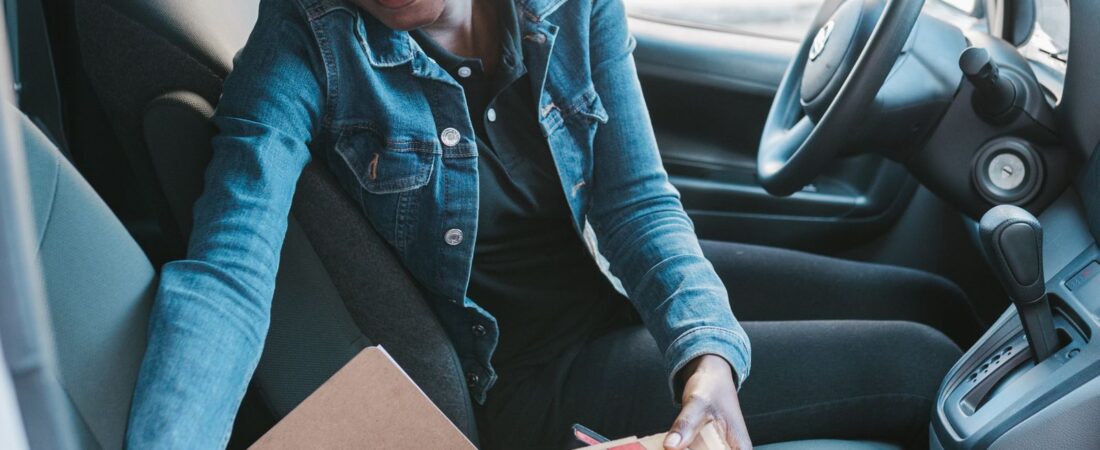

You’re three deliveries into a Friday night shift when it happens. Maybe you slip on a wet apartment hallway floor carrying an order up to the third floor. Maybe someone rear-ends you while you’re sitting at a red light waiting on the next ping. Maybe your knee gives out from getting in and out of the car a hundred times a week for six months straight. Whatever the cause — you’re hurt, you can’t drive, and your brain immediately asks the question most delivery drivers have never actually thought through: does the app cover this?
The honest answer in 2026 is: sort of, sometimes, under very specific conditions — and far less than most drivers expect. The gap between what gig delivery workers assume they’re protected for and what’s actually on the table remains one of the biggest financial blind spots in the industry. This guide breaks it all down, platform by platform, state by state, so you know exactly where you stand before something goes wrong.
Why Most Delivery Drivers Are Locked Out of Traditional Workers’ Comp
Workers’ compensation is the system that pays your medical bills and replaces a portion of your income when you’re injured on the job. For W-2 employees, it’s mandatory in every state — your employer must carry it, and you’re automatically covered from your first day at work, no paperwork required.
Delivery drivers on DoorDash, Uber Eats, Instacart, Spark, and Amazon Flex are classified as independent contractors, not employees. In most of the United States, independent contractors are explicitly excluded from workers’ comp. That’s not a gray area or an oversight — it’s structural. When gig platforms built the delivery economy on contractor classification, they shed the employer obligations that traditional employment carries, and workers’ compensation is one of the biggest ones.
What this means in practice: if a UPS driver breaks their ankle on the job, their employer’s workers’ comp policy kicks in automatically. If a DoorDash Dasher breaks their ankle in exactly the same situation, they’re on their own — unless the platform’s voluntary occupational accident insurance happens to apply to that specific moment. Research compiled in early 2026 noted that approximately 37 states still have no statutory workers’ comp protections whatsoever for independent contractors, leaving millions of gig workers with no automatic safety net when injured at work.
It’s important to understand this gap in the context of other protections. The gig worker pay transparency and protection laws that expanded in 2026 have improved pay floors and deactivation rights in several cities — but they do nothing about the workers’ comp gap. Pay protections and injury protections are two entirely different tracks, and the second one still has enormous holes for drivers in most US states.
What DoorDash’s Occupational Accident Insurance Actually Covers
DoorDash provides coverage for on-the-job injuries — just not through traditional workers’ comp. They offer an Occupational Accident Policy, and the headline numbers sound reassuring: up to $1,000,000 in medical expenses and up to $500 per week in temporary disability payments. There is no enrollment required, no premium you pay out of pocket, and no deductible to meet before benefits start. If you get hurt while on an active delivery, you can file a claim immediately.
Here’s where it gets more complicated.
Coverage only applies during what DoorDash defines as “engaged time” — the window that begins when you accept a delivery request and ends when you complete the drop-off. That’s a much narrower window than most drivers realize. Driving to the restaurant after accepting an order? Covered. Waiting at the restaurant for the food? Covered. Driving to the customer’s door? Covered. But if you’re between deliveries, repositioning toward a busier zone, or sitting in a parking lot waiting for the next ping — you are not covered by this policy, even though you are clearly in the middle of a working shift.
There are also serious limitations in what the policy pays compared to actual workers’ comp:
- No payment for pain and suffering. Occupational accident insurance covers economic losses only — medical bills and a portion of lost wages. There is no compensation for the pain, suffering, or loss of quality of life associated with a serious injury.
- No permanent disability awards. Traditional workers’ comp can provide lifetime structured benefits if an injury permanently prevents you from working. This policy has no equivalent long-term benefit structure.
- No retraining benefits. If a serious injury ends your delivering career and you need to transition to different work, this policy will not fund that retraining.
- The $500/week disability cap is low. If you were earning $1,200 a week across multiple apps before an injury, that $500 weekly benefit replaces less than half your income — and timing for when it actually kicks in varies by claim.
DoorDash also provides a commercial auto liability policy covering up to $1 million in bodily injury and property damage during active deliveries. But that liability coverage protects other people from being harmed by you — not you from your own injuries.
Uber Eats, Instacart, Spark, and Amazon Flex: What Each Platform Provides
The injury coverage picture varies significantly across platforms, and some offer far less protection than others.
Uber Eats
Uber’s occupational accident coverage for delivery couriers mirrors DoorDash’s model closely. Drivers with an active delivery in progress have access to medical expense coverage and temporary disability pay — but only during engaged time. Outside that window, the policy does not apply. Uber also provides contingent auto liability coverage that activates when a driver’s personal insurance won’t cover a particular incident. Like DoorDash, there is no permanent disability coverage and no pain-and-suffering component in Uber’s occupational accident policy.
Instacart
Full-service Instacart shoppers who drive their own vehicle have some occupational accident coverage through the platform, but Instacart’s policies are notably less explicitly documented than those of DoorDash or Uber Eats. In some states, Instacart has offered a modest quarterly healthcare stipend to help shoppers access their own health insurance — but this is not workers’ comp and does not replace lost income from a work-related injury. In states without specific legislation, Instacart shoppers generally carry the least formal injury protection of any major grocery delivery platform. For more on the grocery delivery landscape, see our grocery warehouse delivery guide for 2026.
Walmart Spark
Spark drivers operate under Walmart’s contractor policies, which include occupational accident insurance as a component. The specific benefit levels and the exact engaged-time definitions are not consolidated into a single publicly available document, which creates uncertainty for drivers trying to understand what they’re covered for. If you are an active Spark driver, the best way to verify your current coverage terms is through the Spark Driver app directly under the Safety or Insurance section. For full earnings and strategy details, see our Walmart Spark Driver 2026 earnings and strategy guide.
Amazon Flex
Amazon Flex drivers are explicitly classified as independent contractors and are told during onboarding to carry their own commercial vehicle insurance. Amazon provides some third-party liability coverage during active delivery blocks, but occupational accident coverage for the Flex driver’s own injuries is minimal compared to DoorDash or Uber Eats. Amazon Flex drivers carry some of the thinnest on-the-job injury coverage of any major US delivery platform — a significant risk given the physical demands of package delivery work, which often involves heavier packages and more complex drop-off situations than restaurant food delivery.
California Is the Exception: How Prop 22 Raised the Floor
California’s Proposition 22 — passed by voters in 2020 and upheld by the California Supreme Court in 2024 — created a unique legal framework that requires gig platforms operating in the state to provide real occupational injury protection for app-based workers. Under Prop 22, platforms must provide:
- Occupational accident insurance covering up to $1 million in medical costs for injuries that occur while the driver is actively working
- Disability payments of approximately 66% of a driver’s average weekly earnings if they are unable to work due to an injury sustained while delivering
- Coverage that applies to both driving and non-driving tasks that occur during active work windows
California’s Prop 22 protections are still not equivalent to traditional workers’ comp — there are no permanent disability benefits and no avenue for pain-and-suffering claims — but the 66% wage replacement and $1M medical cap are meaningfully better than what drivers in most other states can access. For California drivers, these protections are active and enforceable in 2026.
The “Engaged Time” Loophole That Could Leave You Completely Uncovered
This is the part that most injury guides for delivery drivers skip over, but it’s arguably the most important section of this entire article. The “engaged time” definition is the single biggest factor determining whether platform insurance pays out — and it is written in a way that consistently creates gaps in coverage for working drivers.
Here’s how the loophole plays out in real-world scenarios:
- You accept a DoorDash order and slip on black ice while walking to your car to start the pickup. You are in engaged time. This is covered.
- You are driving toward a hot zone hoping to catch lunch rush orders and another driver runs a red light and hits you. You have no active delivery accepted. You are not covered by the occupational accident policy.
- You are multi-apping — carrying an active DoorDash delivery while also logged into Uber Eats waiting for an order. DoorDash’s policy applies during the DoorDash delivery window. Uber Eats coverage only activates when a specific Uber Eats order is active. The window between apps is an uninsured gap on both platforms simultaneously.
- You twist your ankle stepping out at a customer’s door, but you had paused the app briefly to respond to a personal text message moments before. This becomes a contested gray area. Platforms have denied claims on the grounds that the driver was not fully “in service” at the precise moment of injury.
- You are parked in a restaurant parking lot waiting for an order you accepted 20 minutes ago. You are in engaged time. You are covered — even if the wait is long.
The practical lesson is this: document every incident immediately, even if it feels minor in the moment. Take timestamped photos, report the injury through the platform’s in-app process right away, and do not delay. Coverage disputes almost always come down to documentation and the exact timing of the incident. Understanding your broader legal context also matters here — see our guide on city-level delivery worker protections in 2026 for which markets have added protections that can affect how platform disputes get resolved.
What’s Changing in 2026: State Laws That Could Reshape Coverage
The workers’ comp gap for gig workers is not invisible to state lawmakers. A wave of legislation introduced in 2026 could materially change the injury coverage picture — and some of it is moving faster than the industry expected.
New York: Bills A10222 and S9813
Introduced in early 2026, these companion bills in the New York State Assembly and Senate would classify app-based delivery workers as employees specifically and only for workers’ compensation purposes. The approach is deliberate in its scope — this is not an AB5-style full reclassification that platforms would immediately challenge. It is a narrow, targeted change: delivery platforms would be required to cover their active drivers under the standard New York State workers’ comp system while they are working.
If passed, delivery workers for DoorDash, Uber Eats, Grubhub, Instacart, and similar platforms in New York would be entitled to actual workers’ comp benefits: full medical coverage with no dollar ceiling, permanent disability protections for career-ending injuries, and no engaged-time loophole that lets platforms deny claims based on which exact minute of a shift the injury occurred. As of mid-2026, both bills remain in their respective Labor Committees and have not moved to a floor vote. But legal analysts covering the gig economy consistently describe this as one of the most significant pending worker protection bills in the country. Watch it closely if you deliver in New York.
Washington State
Washington is already ahead of the curve. The state extends its industrial insurance system — which functions as workers’ comp — to rideshare and delivery drivers while they are actively working. This provides meaningful real-world protection that drivers in most other states do not have access to, and Washington’s model is the blueprint that advocates in other states point to when pushing for similar coverage.
Georgia’s Portable Benefits Act (HB 987)
Taking a different legislative approach, Georgia’s HB 987 passed the House Workforce and Labor Committee in January 2026. Rather than reclassifying gig workers, it would allow independent contractors to access portable benefits — including health insurance, retirement savings, and emergency funds — without changing their employment status. This does not directly fix the workers’ comp gap, but it reflects the broader legislative momentum: across states, there is a growing policy consensus that gig workers need some form of structured protection that the current all-or-nothing contractor model fails to provide.
How to Protect Yourself Right Now Before an Injury Happens
The law is moving in the right direction — but it hasn’t caught up yet. Here’s a concrete action plan every delivery driver should complete in 2026:
Verify Your Platform’s Exact Coverage Terms Today
Open your Dasher app, Uber Driver app, Spark Driver app, or Instacart app and read the actual insurance policy terms — not just the marketing summary on the help page. Know the specific dollar limits, the exact engaged-time window definition, the claims reporting process, and the contact number to use if you’re injured. You need this information before an incident, not while sitting in an ER.
Add a Rideshare or Commercial-Use Endorsement to Your Auto Policy
Most personal auto insurance policies explicitly exclude coverage when the vehicle is being used for commercial delivery purposes. A rideshare or commercial-use endorsement — typically $10 to $30 per month depending on your insurer and state — fills the gap between your personal policy and the platform’s policy during those between-delivery windows. This is the most direct and affordable fix available right now for the engaged-time loophole problem.
Consider a Standalone Occupational Accident Policy
Third-party occupational accident insurance is available for independent contractors and is specifically designed for gig workers. These policies — offered by insurers that specialize in contractor and freelance coverage — can provide higher weekly disability income replacement than the $500/week platform cap, and they can cover gaps between platform policies when you are multi-apping or between engaged windows. If you are delivering 25 or more hours per week, the premium on a standalone policy frequently pencils out when you consider what a 60-day injury would cost you without it.
Build a Three-Month Emergency Fund
This is the most reliable safety net available to you right now, regardless of what any platform covers or any law provides. If an injury sidelines you for 8 to 12 weeks — common with knee injuries, rotator cuff injuries, or anything requiring surgery — a funded emergency reserve is what actually keeps rent paid while a coverage dispute is processed. Our complete guide to delivery driver tax deductions in 2026 covers proven strategies for keeping more of what you earn each week, which directly accelerates building that reserve.
Get Marketplace Health Insurance and Do Not Let It Lapse
Occupational accident insurance covers work-related injuries — not general illness, dental, vision, mental health, or any injury that happens outside of an active delivery window. ACA marketplace plans are the primary health coverage option for gig workers who do not have access to an employer plan. One critical 2026 update: the enhanced subsidies that were available from 2021 through 2025 expired at the end of last year. Mid-income earners are paying noticeably more for marketplace coverage this year compared to recent years. Shop during open enrollment, compare metal tiers based on your actual expected usage, and do not let your plan lapse — an uninsured surgery can wipe out a year of delivery earnings in a single bill.
Know the True Financial Cost of Not Working
Being unable to drive is a double hit: you lose your income and your vehicle costs do not stop — loan payments, insurance, depreciation all continue. Understanding what a 30-, 60-, or 90-day injury sideline actually costs you in total dollar terms — not just missed deliveries but ongoing fixed expenses — shapes how large a safety net you actually need to be protected. Our detailed breakdown of where your delivery income actually goes in 2026 is the best starting point for running that calculation honestly.
The Real Bottom Line on Delivery Driver Injury Coverage in 2026
Platform occupational accident insurance is better than nothing, but it is not a workers’ comp replacement. The engaged-time loophole creates real, uninsured exposure every time you are repositioning, waiting for orders, or working in the gaps between active deliveries. Drivers in California have meaningful Prop 22 protections. Drivers in Washington have statutory coverage through the state’s industrial insurance system. Everyone else is working in a state where a serious injury during an unengaged window could mean zero income, zero platform coverage, and medical bills that take years to climb out of.
Legislation is moving — the New York workers’ comp bills, Georgia’s portable benefits act, the sustained policy pressure from delivery worker advocacy groups across the country — but none of that protects you during the shift you work tomorrow. The practical response is to build your own protection layer today: the right auto endorsement for the between-delivery gaps, a supplemental occupational accident policy if the premium fits your earnings, a marketplace health plan that stays current, and an emergency fund large enough to buy you real time if something goes wrong. That is what genuine financial protection looks like for a delivery driver in 2026 — because the platforms are not fully there yet, and waiting for them to be is a risk no driver can afford to take.
Ready to Start Delivering and Cash In?
Join thousands of drivers already earning — and get a $2,575 guaranteed bonus after completing your first 200 deliveries in select US cities.
New drivers: Sign up through our partner link and start earning today!
Sign Up for Uber Eats and Start Delivering →
Must be 18+. Background check required. Terms apply.