


Driver Opportunity
Want to Earn While You Read?
Join as a new driver and get up to a $2,575 guaranteed bonus after completing your first 200 deliveries in select US cities.
Start Earning Now →New drivers only · Terms apply · Available in select cities
What an AOG Run Actually Is (And Why Airlines Pay So Well for It)
AOG stands for Aircraft On Ground. When an airliner can’t fly — a brake assembly failed inspection, an avionics box threw a fault code, a hydraulic line is cracked — every hour that plane sits costs the airline thousands of dollars in passenger rebooking, crew repositioning, and gate fees. The clock starts the second maintenance flags the part as needed.
That’s where we come in. An AOG courier’s job is dead simple on paper: pick up a specific part from an airline warehouse, a supplier counter, or a freight forwarder’s dock, and get it to the maintenance hangar at the airport — fast, intact, and on time. No food going cold. No restaurant closing early. No surge pricing that evaporates. Just a hard delivery window, a real part number on a manifest, and a dispatcher who will call you every thirty minutes if you’re running behind.
For a driver who already knows how to hustle — who already knows how to read a map, talk to a security guard, and document a handoff — this is the natural next step up from food delivery. The pay reflects the stakes. Local AOG runs regularly pay $45 to $150 per delivery. Regional hot-shot AOG runs pay $0.90 to $1.60 per mile. Do the math on a 120-mile overnight run and you start to see why experienced gig drivers talk about this niche in the same breath as port container drayage and other premium freight work.
Who’s Dispatching These Runs and How the Work Actually Flows
Airlines don’t hire individual couriers directly. They contract with 3PL (third-party logistics) dispatch desks that specialize in time-critical freight — sometimes called hot-shot or AOG logistics providers. These companies maintain a network of owner-operators in every city near a major airport. When an MRO (maintenance, repair, and overhaul) shop calls in a part request, the 3PL dispatcher pings the nearest available driver.
The workflow looks like this: you get a text or app notification with a pickup address, a part description, a delivery address (usually an airline maintenance hangar or cargo facility), and a hard ETA. You accept, you go, you pick up the part against a manifest, you deliver it to the hangar desk, you get a signature, you photograph the delivery confirmation, and you close the job. The dispatcher tracks you the whole time. If you’re five minutes from missing the window, they’re already calling you.
This is structurally very similar to what we already do on DoorDash or Instacart, except the customer is a 400-seat aircraft and the tip isn’t optional — it’s baked into the per-run rate.
If you’ve been thinking about moving into specialty freight more broadly, it’s worth reading up on box truck and cargo van hotshot freight gigs as a parallel path, because some of the same 3PL desks dispatch both general hot-shot and AOG work.
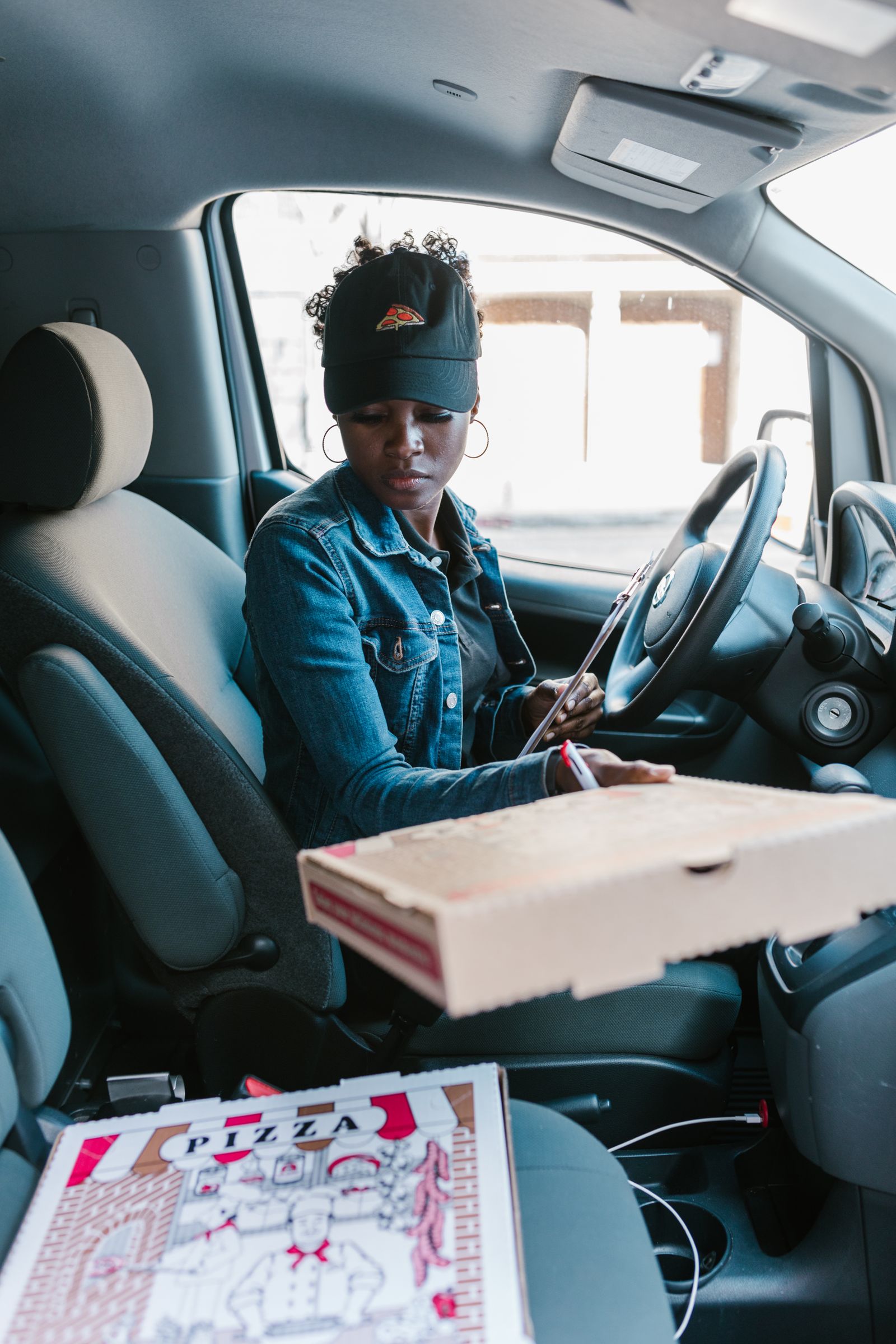
The Paperwork Stack: What You Actually Need to Get Onboarded
This is where most food delivery drivers stop reading — and it’s a mistake. The barrier to entry is real but it’s not high. If you’ve been running a clean gig operation for a year or two, you probably already have most of what’s required.
Licensing and Driving History
You need a valid driver’s license and typically three or more years of licensed driving history. The 3PL will pull your MVR (motor vehicle record). A recent at-fault accident or a DUI in the last five years is usually disqualifying. A minor speeding ticket probably isn’t, but check with each dispatcher. This is stricter than DoorDash’s background check but not as demanding as a CDL carrier’s standards.
Insurance: The Number That Matters Most
This is the one that surprises new applicants. Standard personal auto insurance won’t cover commercial delivery of freight. Most AOG 3PLs require commercial auto coverage with limits of at least $100,000 per person / $300,000 per occurrence, and some ask for $1 million combined single limit for regional runs. You will need to provide a certificate of insurance (COI) naming the 3PL as an additional insured.
If you’re not sure whether your current policy covers commercial freight runs, stop and read our complete delivery driver insurance guide before you apply anywhere. Getting the coverage wrong isn’t just a paperwork problem — it’s a liability exposure that can follow you for years.
The SIDA Badge and Why It Changes Everything
SIDA stands for Security Identification Display Area. It’s the airport-issued credential that lets you access secured areas beyond the public terminal — maintenance ramps, cargo aprons, and airline hangar complexes. Not every AOG run requires airside access, but the ones that do pay significantly more and are harder to staff, which means less competition for you.
Getting a SIDA badge requires a TSA-mandated background check (fingerprints, criminal history, immigration status), a sponsoring employer or vendor (the 3PL or the airline itself can sponsor you), and a fee that varies by airport — typically $50 to $200. The process takes two to six weeks. A TWIC card (Transportation Worker Identification Credential), used at seaports, is a separate credential, though drivers who already hold a TWIC often find the background check process for a SIDA badge moves faster because the records already exist in federal databases.
If you’ve done any work in secured industrial environments — think the kind of specialized runs covered in our piece on data center hardware delivery — you already understand the basic cadence of badging in and out and keeping your credential visible. AOG is the same discipline applied to aviation.
The Parts Themselves: What You’re Carrying and What Fits in What Vehicle
Most AOG parts are not large. Airlines engineer their supply chains to move critical components by sedan or SUV because that’s the fastest vehicle available on short notice. Here’s a breakdown of what you’ll commonly encounter:
- Brake assemblies and brake pads: Heavy but compact. Usually in a manufacturer’s box that fits easily in a sedan trunk.
- Avionics boxes (LRUs — line replaceable units): These are ruggedized electronics modules. Some are briefcase-sized; others are larger and require an SUV or cargo van. They are static-sensitive and must be carried in ESD (electrostatic discharge) packaging, which the supplier provides.
- Hydraulic lines and fittings: Usually coiled or bundled, fits a sedan. Treated as hazmat in some configurations — always ask the dispatcher before accepting if you’re unsure about hazmat endorsement requirements.
- Aircraft tires: Varies wildly by aircraft type. A regional jet tire fits an SUV cargo area. A wide-body main gear tire requires a van or flatbed.
- Interior components (seat parts, galley hardware, overhead bin latches): Usually the least demanding. Fits almost anything.
- Tooling and calibration equipment: Can be large and heavy. Confirm dimensions before accepting.
The practical advice here: start with a clean sedan or SUV, tell the dispatcher exactly what cargo area dimensions you have, and let them match you to appropriate loads. Trying to accept a job your vehicle can’t handle and then calling to cancel at pickup is one of the fastest ways to lose standing in a 3PL’s dispatch queue.
Regular maintenance of whatever vehicle you’re running is non-negotiable at this level. A breakdown on an AOG run is not just a missed delivery — it can end your relationship with that dispatcher entirely. Stay current on your delivery driver car maintenance schedule before you start taking these calls.
How AOG Pay Compares to What You’re Making Now
Let’s be honest about the numbers, because the comparison is the whole point of this article.
| Gig Type | Typical Hourly Equivalent | Per-Run Range | Night/Weekend Premium |
|---|---|---|---|
| Food delivery (DoorDash/Uber Eats) | $14-$22/hr after expenses | $3-$12 per order | Modest surge pricing |
| Grocery/retail delivery (Instacart/Spark) | $15-$24/hr after expenses | $8-$25 per batch | Minimal |
| AOG courier (local) | $28-$45/hr equivalent | $45-$150 per run | Significant — peak windows pay more |
| AOG hot-shot (regional) | $35-$60/hr equivalent | $0.90-$1.60/mile | Yes — overnight runs command top rates |
The hourly equivalent on AOG runs looks strong, but factor in the insurance cost, the time investment in badging, and the reality that you won’t be running AOG calls eight hours a day in your first months. Most drivers blend AOG runs into an existing schedule — they keep their food delivery apps running during slower daytime hours and keep their phone available for AOG dispatch notifications during peak windows. That’s the real play.
On the tax side, the mileage math changes when you’re getting paid per mile explicitly on regional runs versus estimating your cost basis on food delivery. It’s worth revisiting standard mileage vs. actual expenses once your AOG volume grows enough to matter, because the deduction strategy that works for DoorDash may not be optimal for a courier who’s racking up 1,500 miles a week on hot-shot runs.
Peak Windows, Storm Events, and the Calls That Pay Best
If you’ve been running food delivery long enough, you know that 10pm on a Friday during a snowstorm is peak money. AOG works on a similar principle, just with higher stakes and bigger payouts.

The 10pm to 6am Window
Airlines schedule most heavy maintenance overnight when their aircraft are out of revenue service. That means parts calls peak late. A brake assembly that gets flagged at 11pm needs to be at the hangar by 2am so the plane can be back in service for the 6am departure bank. Drivers who make themselves available during these overnight windows consistently report the best per-hour earnings because the pool of available couriers is smaller and the urgency is highest.
This is also when the gate procedures matter most. Maintenance hangar complexes have their own after-hours entry protocols — sometimes a different badge reader entrance, sometimes a guard shack that requires you to call ahead. Your dispatcher will have this information, but ask specifically on your first few overnight runs so you’re not sitting at a locked gate at 1am trying to figure out the right phone number.
Weather Events and Irregular Operations
When a major storm diverts flights, routes aircraft to unexpected airports, or causes a spike in hard landings that trigger mandatory inspections, AOG parts requests surge. Airlines call it irregular operations (IROPS). For couriers, an IROPS event in your metro area can mean back-to-back runs for six to twelve hours. The same weather that tanks your food delivery earnings because restaurants close early can be the event that fills your AOG queue.
The parallel here to our broader delivery work is real — if you’ve ever used peak season delivery strategy to position yourself for the highest-demand windows, you already think the right way. AOG peak strategy is the same instinct applied to aviation maintenance cycles instead of restaurant dinner rushes.
What Gets You Dropped
On-time delivery (OTD) is the only metric that matters in AOG logistics. A 3PL that misses its OTD commitments to an airline loses the contract. That means a single late delivery that you caused — not traffic, not the part not being ready, but you not being where you said you’d be — can get you removed from the dispatch queue permanently. There are no second chances the way there are on food delivery platforms where a bad rating week can be recovered with a good rating week.
The other common mistake is communication failure. If you’re stuck in traffic, you call the dispatcher now, not when you’re fifteen minutes late. If you can’t find the pickup counter, you call before you spend twenty minutes wandering a cargo facility. Dispatchers in this space are professionals who are managing multiple runs simultaneously. They respect drivers who communicate early and drop drivers who go silent.
How to Actually Get Started in 2026
The practical path is straightforward, even if it takes a few weeks to complete.
First, audit your current situation: check your MVR (most states let you pull it online for a small fee), confirm your insurance situation with your broker, and be honest about whether your vehicle is in the kind of condition that won’t embarrass you in front of an airline maintenance foreman. If your car has 180,000 miles and a check engine light, address that before you apply anywhere.
Second, search for 3PL and AOG logistics companies that operate out of your nearest major airport. Look specifically for companies that describe themselves as time-critical freight, AOG logistics, or hot-shot courier networks. Many have online owner-operator applications. The onboarding process typically involves a document submission stage (license, MVR, insurance COI), a brief phone or video interview, and then a waiting period while they verify your records and process any badge sponsorship paperwork.
Third, if you’re serious about the airside access tier, start your SIDA badge application simultaneously. The background check takes time regardless of how clean your record is, so running it in parallel with your 3PL onboarding compresses the timeline.
If you want to see what other specialty courier niches look like before you commit to AOG specifically, our piece on medical imaging and diagnostic equipment courier work covers a similarly high-stakes, time-critical delivery category that some drivers use as a stepping stone or a parallel income stream. The documentation culture and the communication expectations are very similar.
It’s also worth understanding that AOG courier work sits inside a broader ecosystem of specialty freight that rewards drivers who build credentials over time. If you eventually want to scale up to a cargo van or box truck, the relationships you build at the 3PL level in AOG logistics translate directly — many of the same dispatch desks that run AOG also handle other time-critical freight categories.
The Mindset Shift From Food Delivery to Aviation Logistics
The biggest adjustment isn’t the paperwork or the gates. It’s the professional standard. Food delivery platforms are designed around high driver turnover — the system is built to absorb a driver who no-shows or cancels. AOG logistics is not. The people you’re delivering to are licensed aircraft mechanics who are accountable to the FAA for every maintenance action they take. They are not interested in excuses. They want the part, they want the manifest, and they want your signature out of their way so they can get back to work.
That sounds intense, and in the first few runs it is. But most drivers who make the transition say the same thing: it’s actually less stressful than food delivery once you’re in the rhythm, because the expectations are clear, the pay is reliable, and the customers — maintenance managers and their teams — are consistent and professional. There’s no equivalent of a customer who marks a delivery as not received after you photographed it on their doorstep.
If you’re currently running multiple food delivery apps to maximize your hourly rate — the kind of strategy covered in resources on multi-apping across DoorDash, Uber Eats, Instacart, and Spark — think of AOG as the next tier up rather than a replacement. Keep your food delivery accounts active during hours when AOG calls are slow. Be available for AOG dispatch during overnight and weekend windows. That hybrid approach is how most drivers build their AOG reputation before transitioning to it as a primary income source.
The gig economy has always rewarded drivers who are willing to go where the barriers are slightly higher than everyone else wants to clear. A SIDA badge and a commercial insurance policy are not glamorous investments, but they put you in a category of driver that most of the people on the DoorDash waitlist will never reach. That’s the whole point.
Driver Opportunity
Ready to Start?
Turn This Guide Into Real Income. Join as a new driver and get up to a $2,575 guaranteed bonus after completing your first 200 deliveries in select US cities.
Sign Up & Start Delivering →New drivers only · Terms apply · Available in select cities
Start where you are: pull your MVR this week, call your insurance broker about commercial coverage, and look up the AOG and time-critical freight 3PLs operating out of your nearest major airport. Pick one to apply to. The paperwork stack takes a few weeks to clear, and your first run will feel different from anything you’ve done in a delivery vehicle before — in the best way.