
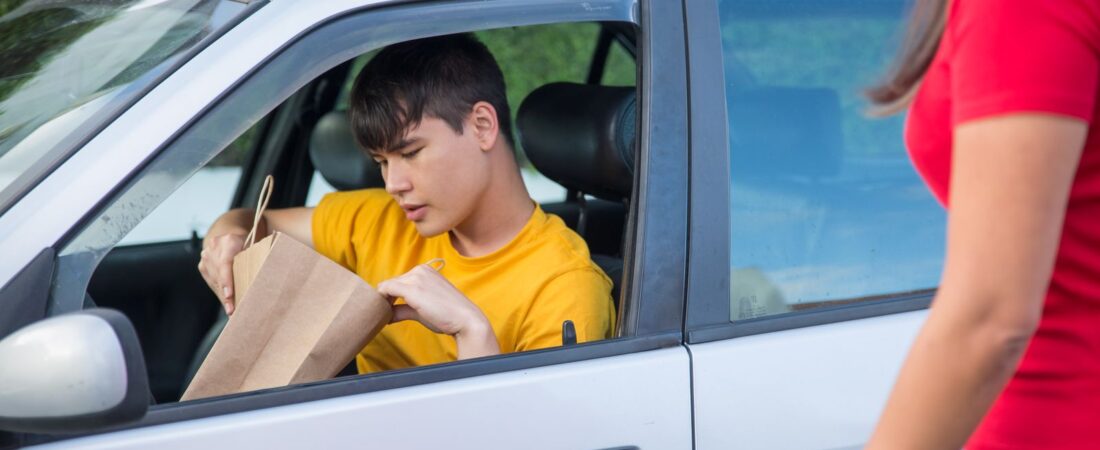

Something changed in the offer queue this year. Mixed in with the $6.50 burrito runs and the endless grocery batches, there is now a different animal: a 34-item Target order, a Home Depot run with two bags of concrete, a Best Buy pickup for a 65-inch TV. Retail is where the order volume is growing, and if you have been declining those offers on instinct, you have probably been leaving real money on the table.
Driver Opportunity
Want to Earn While You Read?
Join as a new driver and get up to a $2,575 guaranteed bonus after completing your first 200 deliveries in select US cities.
Start Earning Now →New drivers only · Terms apply · Available in select cities
I have been running DoorDash, Uber Eats, Instacart and Spark in a mid-size metro since 2021, and retail batches now make up roughly a third of my weekly gross. The pay per mile looks worse on paper. The pay per hour, done right, usually is not. Here is what these offers actually are, which stores send them, and how to tell a good one from a trap before you tap accept.
Why Store-Fulfilled Retail Batches Showed Up in Your Queue
For years, same-day delivery meant restaurants and groceries. In 2026 it means the whole store. DoorDash used its September 30, 2026 Dash Forward event to expand its retail marketplace, and the numbers it published were not small: 30 million retail products added since 2023, and more than 500,000 products now eligible for delivery in as little as an hour to the average US customer.
The 2026 same-day arms race
DoorDash is not alone in this. FedEx launched SameDay Local, Amazon pushed one-hour and three-hour delivery, and Sam’s Club rolled out a one-hour offering, all reported within the same stretch of 2026. Every one of those promises needs a driver at the other end. A lot of those drivers are us.
The practical result is that the same store shelf now feeds three different order pipes: the retailer’s own website, a marketplace app like DoorDash or Instacart, and white-label delivery where the customer never sees the app’s branding at all. From your seat, they all arrive looking like an offer card with a payout and a mileage number.
Why they look nothing like a restaurant offer
A restaurant offer is a straight line: drive to the restaurant, wait, drive to the customer. A retail batch is a triangle. You drive to the store, you spend time inside finding or waiting for items, then you drive to the customer, then you often drive back to a zone. The in-store segment is the part that kills new drivers, because it is unpaid time that does not show up in the mileage figure.
Retail batches also carry tip behavior that differs from food. Marketplace orders from Target or Sephora tip like a normal delivery. Some white-label orders carry a flat delivery fee with no tip line at all. That difference is worth more than any other single factor when you are deciding what to accept.
Store by Store: What Each Retail Partner Actually Sends
After a few hundred of these, the patterns are predictable enough to plan around. This is what each store tends to put in front of you.
Target
Target is the best all-around retail batch in most markets. Order size is usually modest, items are light, and the store layout is consistent enough that you learn where the pickup counter is in one visit. The mix skews toward household basics, health and beauty, and small electronics. Tips are decent because most of these orders come through the consumer marketplace rather than a white-label contract.
The catch is store wait time. Target pickup can run 15 minutes at a busy hour, and that is the difference between a $26 hour and a $17 hour on the same batch.
The Home Depot and Lowe’s
Home improvement is the highest-paying and most physically demanding category on this list. The Home Depot has been on DoorDash since January 2025 and is included in DashPass, which means steady volume. What you get is lumber, concrete, paint, water heaters, and bags of soil. Ten bags of mulch is a normal Tuesday.
Do not accept a home improvement batch in a sedan unless the item list is short and clearly light. A 50-pound bag of concrete mix will ruin your suspension and your trunk liner, and a 4×8 sheet of plywood will not fit in anything short of a truck or a van. When these work, they pay $30 to $45 for 40 minutes of real work. When they go wrong, you are the guy apologizing in a parking lot with a cracked bumper.
Best Buy
Best Buy runs through Instacart for same-day in as fast as an hour, and it is the category that decides whether you need a bigger vehicle. Small pickups like headphones and chargers are easy money. TVs, monitors and soundbars are not. Anything over 43 inches needs to be measured against your cargo opening before you accept, not after.
Best Buy batches also tend to attract low tips because the customer already paid for premium same-day shipping. Treat the base pay as the whole pay and decide from there.
Sephora, Dick’s and Tractor Supply
These three are the sleeper categories. Sephora orders are small, light, high-value, and frequently tip well because the customer is buying a gift. Dick’s sends apparel and small fitness gear with occasional bikes and kayaks, so check the item list carefully. Tractor Supply is rural and can mean feed bags, fencing, and a 20-mile drive each way.
The pattern across all three: small item count and short mileage is the signal. Long mileage with a heavy item list is the warning.
The Math That Decides Whether a Retail Batch Is Worth It
Most drivers evaluate every offer on dollars per mile because that is what the card shows. That metric was built for restaurant delivery and it breaks completely on retail.
Dollars per total hour, not dollars per mile
Total time means drive to store, plus time inside the store, plus drive to the customer, plus the drive back to a productive zone. Divide the payout by that number and you get the only figure that matters. A retail batch that pays $22 for 6 miles looks great at $3.67 per mile. If it eats 50 minutes of your hour, it is a $26 hour, which in most markets is fine but not special.
A worked example
Offer A: restaurant, $9 payout, 4 miles, 22 minutes door to door. That is $24.50 an hour and $2.25 per mile. Offer B: Target, $22 payout, 6 miles, 48 minutes including 14 minutes of store wait. That is $27.50 an hour and $3.67 per mile. Offer C: Home Depot, $31 payout, 11 miles, 70 minutes including loading. That is $26.50 an hour and $2.80 per mile.
All three are close. The difference is that B and C are more predictable and less likely to be stacked with a second order, while A can be doubled up with a second restaurant run in the same window. That is why retail batches are best used as anchors: take one good retail batch, then fill around it with short food runs instead of the other way around.
Heavy, Bulky and Oversize: What to Take and What to Pass
Weight limits are where new retail drivers lose money fastest. The platform will happily hand you a 200-pound order because the store and the customer both agreed to it. Nobody asked your car.
My hard rules after two years: nothing over 50 pounds in a sedan, nothing that cannot fit fully inside the trunk or the back seat, no furniture without a second person, and no order where the item list includes the words “assembled,” “panel,” “sheet,” or a dimension in feet. Furniture and appliances are almost always a two-person job presented as a one-person payout.
The gear that pays for itself
A $12 tape measure, a $25 ratchet strap set, a $40 folding hand truck and two moving blankets cost less than one bumper repair. I keep all four in the car. The hand truck alone has saved me from declining three of my best-paying batches this quarter, because it turned an impossible 80-pound order into a five-minute load.
Protect the car and protect your back. Lift with the load close to your body, never twist while carrying, and slide heavy items across the trunk lip instead of lifting them over it. A back injury ends your earning capacity for weeks, and no batch on earth pays enough to cover that.
Returns, Post-Purchase Pickups and the New Order Type
Dash Forward 2026 also introduced post-purchase returns handled by Dashers. That created an order type most drivers have never seen before: you pick up a return from a customer’s porch and take it back to the store. There is no food to keep hot, no customer to hand off to, and usually no tip.
Returns are quick and low-stress when the store is on your route. They are a trap when the return destination is 12 miles in the wrong direction. Read the destination before you accept, because the pickup address is what shows on the card and the store is what actually matters. If you already run package returns, the workflow is nearly identical to what I described in my package return pickup guide, with the store counter replacing the carrier desk.
The Q4 Retail Calendar From Black Friday to the Dead Week
Retail batch supply is not flat across the quarter. It runs in three distinct waves, and each one rewards a different strategy.
Black Friday week
This is the highest-volume retail week of the year, and it is also the worst week for store wait times. Pickup counters are buried, parking is a war zone, and a 15-minute wait becomes 35. The winning move is to work early mornings and late evenings, skip the 11 a.m. to 4 p.m. window entirely, and favor stores with dedicated pickup doors. My full breakdown of that week is in the Black Friday and Cyber Monday driver guide.
The two weeks before Christmas
This is the best retail window of the year and the one most drivers underwork. Volume stays high while food delivery cools off, because people are home with family and cooking instead of ordering takeout. Retail batch pay climbs, surge zones widen, and the same stores keep sending the same item types. If you only work one stretch of Q4, work this one.
Pair it with the sequencing in the holiday peak season playbook so you are not burning your best hours on low-value offers. If you are running multiple apps through December, the peak pay and surge zone guide covers how boost windows stack on retail volume.
The week after
Volume collapses. Returns spike. The smart play is to switch from outbound retail to return pickups and clearance runs, and to use the downtime for the maintenance you have been postponing. Dead miles are cheap this week, which is exactly why you should not be chasing them. If you want a longer view on unpaid driving, my piece on dead mileage explains why the post-Christmas week quietly ruins January earnings for drivers who do not adjust.
Multi-Apping for Retail Batches Without Wrecking Your Rate
Retail batches stack well with each other and badly with food. Two Target batches heading the same direction is close to free money. A Target batch plus a restaurant order with a 20-minute promise is how you end up with a contract violation.
The rule I use: never accept a retail batch with a delivery window under 60 minutes if I am already on another order, and never accept a second order once the retail batch is loaded and the customer has been notified. Retail customers are usually home and waiting, and they are far more likely to rate you one star for lateness than a restaurant customer who is still deciding what to watch.
Keep completion rate sacred. Retail batches are fewer and larger, so a single cancellation costs proportionally more of your weekly gross than it would in food. If you need more volume and you are not yet signed up everywhere, adding a second app is the fastest route to a second queue of retail and restaurant offers in most metros.
Seven Mistakes That Cost Retail Drivers Money
- Judging by dollars per mile. The 6-mile retail batch at $22 beats the 2-mile food order at $7 almost every time once store time is counted.
- No measuring tape. Guessing whether a box fits is how you lose 20 minutes and a completion point.
- No straps. A tipping water heater in an empty trunk is a claim waiting to happen.
- Ignoring store wait. Two 15-minute waits turn a $30 hour into an $18 hour.
- Taking 60-item orders in a sedan. Item count predicts loading time better than anything else on the card.
- Accepting a return with an unknown destination. The store is the address that matters.
- Chasing the wrong week. The two weeks before Christmas pay better than Black Friday week and are half as crowded.
Your Retail Batch Checklist
Before you tap accept on the next store order, run this in ten seconds: item count under 15, weight under 50 pounds, no furniture or assembled goods, store within 4 miles, delivery within 8 miles of the store, payout at least $18, and a delivery window over 45 minutes. Every box you can tick raises the odds that this is a $28 hour instead of a $16 one.
Driver Opportunity
Ready to Start?
Turn This Guide Into Real Income
Sign Up & Start Delivering →New drivers only · Terms apply · Available in select cities
Retail batches are not a side hustle anymore. They are the fastest-growing slice of same-day delivery in the country, and the drivers who learn the store-by-store patterns early are the ones who will still be earning well when the restaurant queues dry up in January. Learn one store per week, keep the tape measure in the car, and stop pricing your time by the mile. The drivers who build that habit this quarter will out-earn the ones who keep chasing the shortest distance for the rest of the year.