


You already own the most expensive piece of equipment for moving jobs: a vehicle. You already know how to navigate a city fast, handle a full-day physical schedule, and deal with customers under pressure. While other drivers are squeezing $12–$15 an hour out of food delivery on a slow Tuesday morning, delivery drivers who added moving-help gigs to their rotation are pulling $150 to $400 for a single weekend shift — and right now, September and October, is still the hottest stretch of moving season across most of the US.

This guide breaks down the five best moving-helper and junk-removal apps, real pay rates from actual workers (not the inflated claims on app websites), vehicle requirements by tier, and how to stack moving jobs into the dead hours of your existing delivery schedule so you are not leaving money on the table during the highest-demand stretch of the moving calendar.
Why Right Now Is the Best Window to Add Moving Help to Your Gig Stack
Moving season in the United States runs from May through September — but the tail end of that window, September and October, is a hidden sweet spot that most gig drivers overlook. The brutal summer heat has broken in Sun Belt markets like Phoenix, Houston, and Dallas. College apartment swaps are wrapping up. Lease-end turnover is happening citywide. And job-relocation moves that got pushed off during the summer scramble are now clearing all at once.
According to moveBuddha’s 2026 peak-season analysis, roughly 40 million Americans move each year, with the highest concentration of apartment-to-apartment moves landing between late August and mid-October. For drivers, that means more moving jobs are posted than there are helpers to fill them, customers are willing to pay premium rates for reliable same-week help, and two-hour morning moving jobs can pay three times what a short-distance food-delivery order does — with time to still catch the lunch-rush delivery window afterward. Fall 2026 also brings a widening gap between peak-season and off-season pricing, which means customers are booking now before movers get booked solid. That urgency pays off for the helpers who are already approved and ready to take jobs.
The Five Moving-Helper Apps That Pay Delivery Drivers Real Money
Not all platforms are built the same. Some pay by the hour, some per job, some require a pickup truck, and a few accept any driver willing to carry boxes. Here is an honest breakdown of each major platform based on 2026 driver reports and third-party data.
Dolly — Best for Drivers Without a Truck
Dolly is the most driver-friendly platform on this list because it does not require a pickup truck. If you have a large SUV, a minivan, or even a hatchback, you can sign up as a “Hand” — the person who does the physical moving alongside a truck-owning “Helper.” Hands earn roughly $18–$28 per hour depending on the city. Helpers with trucks earn $35–$55 per hour for the same job.
Dolly is active in more than 50 US cities, with the strongest job volume in Seattle, Denver, Dallas, Atlanta, Phoenix, and Los Angeles. Onboarding includes a background check and takes about a week. One key difference from food delivery: Dolly jobs are booked in advance, not as last-minute pings. Check the app Sunday night and Monday morning to grab jobs for midweek slots. Drivers who check in consistently get first access to the highest-paying multi-hour jobs before they fill up.
GoShare — Best for Drivers With a Pickup or Van
GoShare matches customers with drivers by vehicle type. Pickup truck drivers earn up to $50–$70 per hour, cargo vans up to $100 per hour, and box trucks up to $180 per hour per GoShare’s published 2026 rate sheet. Real-world driver reports put active-hourearnings for pickups at $36–$65 per hour depending on market and job type.
GoShare operates in over 40 cities including Houston, Dallas, San Antonio, Miami, Chicago, Philadelphia, and New York. Jobs range from single-item furniture hauls ($80–$120) to full apartment moves paying $200–$400 for a three-to-four-hour block. GoShare also posts freight-delivery jobs on the same app, which means fewer dead stretches between moving gigs on any given day.
U-Haul Moving Help — Best for High-Volume Weekend Warriors
U-Haul Moving Help is often overlooked because people assume it requires a U-Haul truck. It does not. As a Moving Help Service Provider, you show up at the customer’s location — a rental truck, a POD container, or just furniture that needs to move to a new floor — and provide loading, unloading, or packing labor. You set your own rate, and U-Haul takes only a 15% platform fee, the lowest cut in the moving-labor industry.
What that means practically: a typical two-person, two-hour loading job is priced at $208–$402 on the customer side. With U-Haul’s 15% cut, you and your partner keep 85% — roughly $177–$342 split two ways, or $89–$171 each for two hours of work. Two Saturday jobs puts $178–$342 in your pocket before expenses. Sign-up is free with no monthly fees, and new providers who build their first five reviews in September will be priority-listed going into the busy October stretch.
TaskRabbit — Highest Hourly Rate in the Moving Category
TaskRabbit consistently shows the highest hourly rates for moving labor — experienced Taskers in major markets charge $60–$80 per hour. Gridwise’s 2026 gig-income report places TaskRabbit’s average moving-task earnings at $38 per hour across all markets, making it the best-paying option for drivers who invest the time to build a strong profile.
The tradeoff: TaskRabbit is competitive. Unlike Dolly or GoShare where the algorithm sends you jobs, on TaskRabbit customers choose you from a profile. Delivery drivers who transition well typically leverage their existing 5-star service record, write a profile that emphasizes reliability and punctuality, and start at the platform’s suggested rate for the first 30 days to build reviews before raising prices. TaskRabbit is particularly strong in NYC, Chicago, Los Angeles, San Francisco, Boston, and Washington DC.
LoadUp — Best for Junk Removal and Dump Runs
LoadUp is the platform for drivers who want to skip the interpersonal side of moving and just haul unwanted items away. Customers schedule junk pickup — old furniture, appliances, mattresses, yard waste, construction debris — and LoadUp dispatches a driver or two-person team to collect, haul to the dump or a donation center, and confirm disposal.
Job payouts range from $55 for a single-item pickup to $200 or more for a full-truck load of mixed junk. LoadUp requires a pickup truck or larger for most jobs, with two-person teams required for bigger hauls in most markets. The platform operates in over 30 US cities, with the strongest volume in Atlanta, Houston, Dallas, Charlotte, Nashville, and Orlando.
What Vehicle Do You Actually Need? The Full Matrix
Here is the vehicle-to-app compatibility breakdown and what each tier realistically earns on an active-hour basis:
| Vehicle Type | Compatible Platforms | Active Hourly Range |
|---|---|---|
| Sedan / Hatchback | Dolly (Hand role), TaskRabbit | $18–$38/hr |
| Large SUV / Minivan | Dolly, TaskRabbit, U-Haul Moving Help | $25–$50/hr |
| Pickup Truck | All five platforms (full access) | $36–$70/hr |
| Cargo Van / Box Truck | GoShare, U-Haul Moving Help, LoadUp | $65–$180/hr |
Even a standard food-delivery sedan gets you onto Dolly as a Hand, earning $18–$28 per hour helping a truck owner with carrying and loading. If you are weighing a vehicle upgrade anyway, a used pickup truck or cargo van dramatically expands your earning ceiling — moving help, freight delivery, and junk removal all open up simultaneously.
Real Earnings: What Drivers Are Actually Taking Home
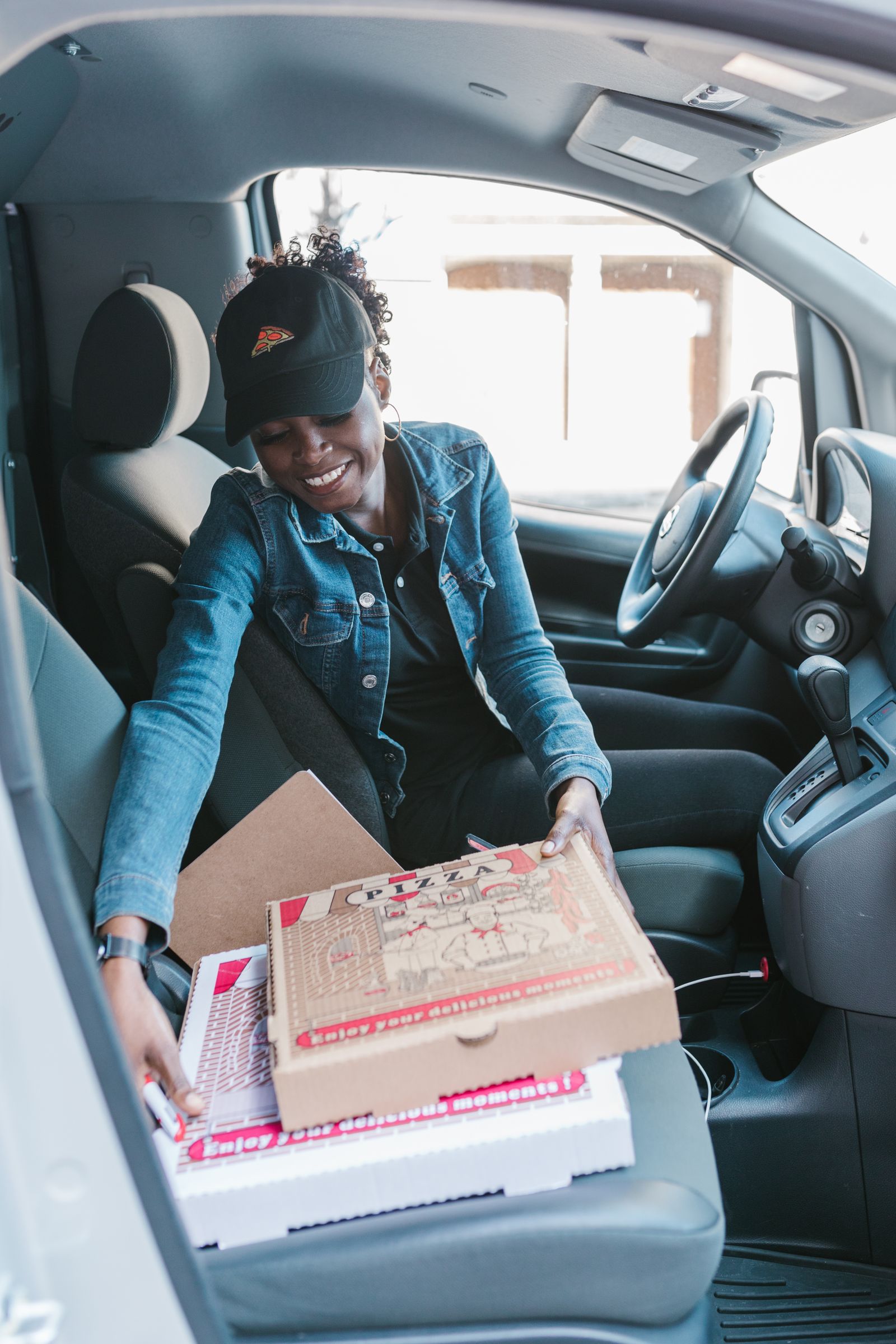
Here are three realistic earning scenarios so you can see what adding moving gigs looks like on a monthly basis.
Scenario A — Sedan Driver, Dolly on Weekends
You run DoorDash or Uber Eats Tuesday through Friday evenings. On Saturday morning, you take one Dolly Hand job: 3 hours at $22/hr average = $66. Two of those per month adds $132 in additional income with no app fee changes and no vehicle upgrade required. It covers a car payment or a month of gas.
Scenario B — Pickup Truck Driver, GoShare + U-Haul Moving Help
Saturday: one GoShare furniture-haul job, 2 hours at $55/hr = $110. Sunday: one U-Haul Moving Help loading job with a partner — customer pays $300, you keep 85% = $255 split two ways = $128 your cut. Weekend gross: $238. Do that consistently through September and October and you add close to $950–$1,000 per month on top of your delivery income.
Scenario C — Full Weekend Blitz, Sun Belt High-Demand Market
Friday evening: two GoShare jobs totaling $180. Saturday: one TaskRabbit moving job, 4 hours at $40/hr = $160. Sunday: one LoadUp full-truck junk removal = $140. Weekend gross: $480. These are the kinds of weekends drivers in Houston, Dallas, and Phoenix are reporting during peak fall moving season in 2026.
Seven Pro Strategies to Maximize Your Moving Gig Income
- Sign up for all five platforms now, even if you only plan to work one. Background checks can take 5–10 days. Get in the queue today so you are ready to accept jobs this weekend.
- Prioritize review-building in your first 30 days. Take any job, any size, any distance. A 10-review profile on TaskRabbit or U-Haul Moving Help unlocks 30–50% higher booking rates. One month of groundwork pays off for a full year of premium jobs.
- Bring your own equipment. A $25 furniture dolly, $15 moving straps, and a pack of moving blankets from Home Depot will immediately separate you from other helpers and earn you better reviews.
- Work with a partner when possible. Two-person teams earn more per job, finish faster, get better reviews, and unlock the higher-paying LoadUp and GoShare jobs that require two people for heavy items.
- Check all five apps on Sunday night for the week ahead. Monday and Tuesday morning jobs often post the night before. Early acceptance improves dispatch priority in some platforms’ algorithms.
- Know your physical limits. Moving is a different kind of physical demand than food delivery. Stretch before each job and use proper lifting technique — legs not back — especially on appliances and full dressers.
- Track every tool and equipment purchase as a business expense. The dolly, the straps, the blankets — they are all deductible. Keep digital receipts from day one.
How to Stack Moving Jobs With Your Existing Delivery Shifts
The smartest play is not to replace your delivery income — it is to fill the dead hours that cost you nothing to recapture. If you already know the best times to deliver on DoorDash, Uber Eats, and Spark, you also know there are windows when orders dry up: Monday mornings, Tuesday and Wednesday 10 a.m. to noon, slow gaps between the lunch and dinner rushes.
Those are exactly the windows when moving jobs land. A 9 a.m. to noon GoShare or Dolly job followed by a lunch-rush delivery shift from noon to 3 p.m. is a legitimately strong block that can gross $100–$200 depending on your market. This is the same logic behind multi-apping across delivery platforms — the difference is you are now expanding beyond food delivery entirely into higher-paying physical-labor gigs.
The mileage math works in your favor too. Moving jobs typically cluster within 10–20 miles of your normal delivery zone. Positioning near apartment complexes and storage facilities in the morning — where moving jobs concentrate — also puts you near residential neighborhoods for the lunch surge. You are not adding dead mileage; you are converting would-be dead time into paid moving work.
The Tax Advantage: Every Moving Mile Is Deductible
Every mile you drive for a moving-help gig is a business mile. Whether you are positioning to a GoShare pickup, driving to a U-Haul Moving Help customer’s address, or hauling a truckload of junk to the donation center for LoadUp, those miles count at the IRS mileage rate of 76 cents per mile for 2026. Drivers who use a single vehicle across multiple gig platforms — food delivery and moving both — deduct the full business-use percentage of all miles. Track every mile from day one using MileIQ, Hurdlr, or Stride. Equipment purchases — the furniture dolly, moving straps, blankets — are also deductible business expenses.
Where Moving-Help Demand Is Hottest Right Now (September–October 2026)
If you are in one of these markets, the window is open right now and will stay strong through late October:
- Houston and Dallas: September is when Texans finally move after the summer heat breaks. Apartment complexes along the Energy Corridor, Uptown Dallas, and Las Colinas see heavy turnover all month.
- Phoenix and Tucson: Nobody moved furniture in 115-degree July. September and October are peak relocation months here.
- Chicago and Atlanta: College semesters just started, lease-end moves are happening citywide, and corporate relocations delayed from summer are clearing now.
- New York and Los Angeles: Year-round demand, with a concentrated September wave as summer sublets end and fall leases begin.
- Las Vegas and Orlando: Hospitality-worker relocations, strong demand through October as people migrate in from summer-heat regions.
To maximize your bookings in these cities, keep your acceptance rate high in your first 30 days, respond to job requests within minutes (faster response improves dispatch priority on Dolly and GoShare), and apply the same rating-protection habits you use on delivery apps — punctuality, clear communication, and no-surprises professionalism transfer directly to moving gig platforms.
If you want to bulletproof your overall gig income while expanding into new categories, this guide on protecting your gig driver account in 2026 covers the account-management fundamentals that apply whether you are delivering food or loading a U-Haul truck on a Saturday morning. Your gig income is worth protecting — and right now, so is every hour of peak moving season you have left.
Ready to Start Delivering and Cash In?
Join thousands of drivers already earning — and get a $2,575 guaranteed bonus after completing your first 200 deliveries in select US cities.
New drivers: Sign up through our partner link and start earning today!
Sign Up for Uber Eats and Start Delivering →
Must be 18+. Background check required. Terms apply.