
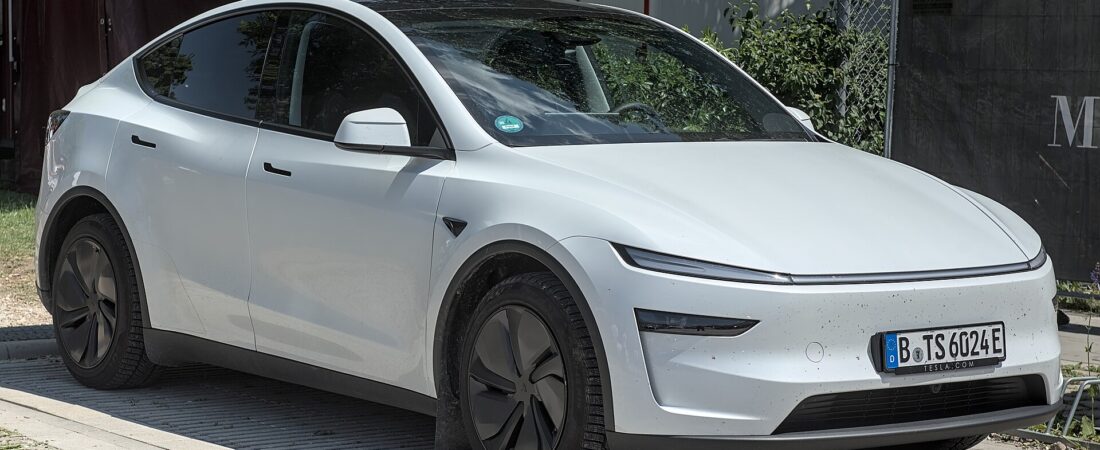

If you live within a few hours of the US-Canada border, or if you have a cross-border drive already on your calendar, Tesla’s one free month of FSD (Supervised) through its referral program is not just a trial of highway automation on familiar roads. It is a rare chance to stress-test a camera-only driver-assistance system against exactly the conditions that expose its real limits: a legal boundary where your speedometer switches units mid-trip, bilingual and metric road signs, provincial construction-zone rules that differ from anything on the US side, and a Supercharger network that must hand navigation context across two countries. This article explains how to use that month deliberately, who can actually redeem it, and what a Canadian buyer should do when the program does not apply to them.
Disclosure: This post contains a referral link. If you order a Tesla using it, the author may receive referral benefits at no extra cost to you.
Tesla Referral Offer
Get One Month of Full Self-Driving Free
Order a new Tesla through this referral link and get one month of FSD (Supervised) at no cost. Referral code: willy327274
Claim Free FSD Month →New orders only · Terms apply · Offer availability varies by region
What FSD (Supervised) Actually Is Before You Cross Anything
Before planning any border run, it is worth being precise about what you are testing. FSD (Supervised) is an SAE Level 2 driver-assistance system. That classification has real legal weight: the driver must remain attentive at all times, keep their hands ready to take the wheel, and keep their eyes on the road. The cabin camera monitors driver attention and will issue warnings or suspend the feature if you look away. The vehicle is not driving itself. You are driving, with the system offering steering and speed suggestions that you can override or ignore at any moment. Tesla’s own branding includes the word ‘Supervised’ for exactly this reason.
That is not a caveat to gloss over. When you cross into Quebec at night in November and a construction zone appears with signage that the camera did not expect, the system may disengage. You need to be ready. For a full breakdown of how FSD (Supervised) behaves under NHTSA scrutiny and the open engineering analysis covering roughly 3.2 million vehicles, see our FSD safety data and regulatory status guide.
Referral Program Mechanics: The Honest Version
Tesla launched the FSD (Supervised) referral program in the United States on October 29, 2026. It is a software-only, owner-to-owner program redeemed through the Tesla app at version 4.62.0 or later. A new buyer who has not held an FSD subscription or redeemed an FSD trial in the prior 12 months can receive one free month of FSD (Supervised) when they use a valid referral link from an existing owner.
The referring owner earns one free FSD month if they subscribe, or a $99 Tesla Credit if they already bought the feature outright. Referrer benefits are capped at 12 per calendar year, with a lifetime cap of 48, and each benefit expires 12 months after it is granted. New US buyers pay $99 per month for FSD (Supervised) after Tesla ended outright US sales on February 14, 2026.
If you are a new US buyer and want to redeem a free trial month before committing to that subscription, you can use a referral link such as this Tesla referral link at the time of your purchase. The month activates through the app after delivery.
Canadian Buyers Cannot Redeem the US Referral Program
Canada is not included in the FSD (Supervised) referral program. Tesla has announced no start date for a Canadian equivalent. If you are a Canadian buyer, you cannot use a US referral link to unlock the free month, and no workaround changes that. Any source telling you otherwise is wrong. If a friend or seller suggests you can redeem the US link at a Canadian delivery, do not rely on it.
What a Canadian buyer can do: contact Tesla Canada directly to ask whether any promotional trial period is available at time of purchase, monitor the Tesla Canada website for program announcements, and in the meantime evaluate FSD (Supervised) qualitatively through test drives at a Tesla store. Canadian FSD pricing is in Canadian dollars; we are not quoting a figure here because Tesla’s pricing has changed and the program structure for Canada remains unannounced. For everything else a Canadian owner needs to know, including provincial rules, winter tire requirements, and Supercharger coverage, see our complete Canada FSD guide for 2026.

What Actually Changes When You Cross the Border
The single most underappreciated risk in a US-to-Canada or Canada-to-US drive with FSD (Supervised) active is the unit switch. Your Tesla displays speed in mph in the United States and km/h in Canada. The in-car UI is designed to switch automatically when you cross, but the driver must confirm the displayed units are correct after every border crossing, because a misread unit is a genuine speeding risk. 100 mph and 100 km/h are not the same number, and a moment of inattention when you are already managing a border queue, customs paperwork, and lane assignment is exactly when a misread is most likely.
Beyond units, here is what changes operationally for the system:
- Metric signage: Speed limits, distances, and warning signs switch to metric. FSD (Supervised) reads posted speed limits via the cameras. If a sign is partially obscured by snow or a truck, the system may default to a stored map speed that differs from the posted limit.
- Bilingual signage: Quebec and New Brunswick post signs in French and English. The system’s sign-reading is trained on a large corpus, but bilingual or French-only signs in rural Quebec present a different visual pattern than what most US drivers encounter.
- Construction zone rules: Provincial construction-zone speed reductions and fines differ significantly from US state rules. The system may not reduce speed as aggressively as the law requires. You need to monitor and override.
- Rural highway geometry: Canadian provincial highways, especially in Quebec and Ontario away from major corridors, can include tighter curves, unmarked intersections, and lane widths that differ from US interstate standards.
Supercharging and Connectivity Across the Border
The good news for cross-border drivers is structural: Tesla’s Supercharger network uses the NACS connector standard on all current Tesla vehicles in both markets, and the in-car navigation handles cross-border route planning natively. When you enter a destination in Canada from the US (or vice versa), the route planner will include Supercharger stops in both countries without any manual configuration.
The Tesla app handles billing for Supercharging in both countries through your account. Rates differ between countries and are displayed in the local currency at the charger. No separate network membership is required.
Connectivity is a different story. FSD (Supervised) depends on a live data connection for certain features, including over-the-air map updates, speed limit data corrections, and software updates. When your phone and your car’s onboard connectivity switch to Canadian roaming, data costs can increase and speeds can degrade depending on your carrier plan. Features that rely on fetched data may respond more slowly. The core camera-based driving behavior does not require connectivity to function, but map-dependent speed limit corrections and navigation updates do.
What to Do Before You Cross
- Confirm your carrier plan includes Canada data at reasonable rates, or purchase a temporary Canadian SIM.
- Download offline maps for the Canadian leg of your route before departure while on home Wi-Fi.
- Charge to a higher state of charge before crossing if the first Canadian Supercharger is more than 150 miles or 240 km away.
- Note the Tesla app version on your car and phone. The referral program requires app v4.62.0 or later; ensure your car has received any pending software updates before the trip.
Provincial and State Rules That Matter to a Supervised-FSD Driver
Because FSD (Supervised) is an SAE Level 2 system, provincial and state hands-free and distracted-driving statutes apply to you as the driver in exactly the same way they apply to any other driver. You are legally operating the vehicle. Here are the most relevant rule categories to research before your specific route, described qualitatively because dollar amounts and specific statute numbers change:
Quebec Winter Tire Requirements
Quebec mandates winter tires during a defined seasonal window. If you are crossing into Quebec during that window without compliant tires, you face fines regardless of whether FSD is active. Winter tires also affect the system’s traction behavior, particularly in lane changes and during speed adjustments on packed snow. See our detailed FSD winter and Snow Belt driving guide for a full breakdown of how tire choice interacts with Level 2 assist systems in cold weather.
Hands-Free Statutes in Canadian Provinces
Every Canadian province has distracted-driving legislation. Using your phone to adjust the Tesla app while driving, even at a stop, can result in a fine. Because FSD (Supervised) requires you to stay engaged, this is not a theoretical concern: if you try to manage the app to extend or modify your trial while driving, you may be breaking provincial law. Make all app adjustments before moving or pull over safely.
Construction Zone Automated Enforcement
Several provinces use automated speed enforcement in construction zones. The posted reduced speed applies whether a human worker is present or not in many jurisdictions. FSD (Supervised) may not reduce speed to the construction-zone limit without driver intervention. Watch the posted signs and apply the brake if the system does not respond quickly enough.

A 30-Day Cross-Border Test Plan
If you are a US buyer who has just redeemed the free referral month and you have a cross-border trip planned or possible, here is a structured four-week plan for getting maximum signal from the trial. For a general 30-day evaluation framework not focused on cross-border driving, see our 30-day referral trial evaluation guide.
Week 1: Home Turf Baseline
Spend the first week driving exclusively on roads you know well, in conditions you can predict. The goal is not to test the system against novelty; it is to establish a baseline for how FSD (Supervised) handles your normal commute, your local highway on-ramps, and your neighborhood. Note every intervention you make: how often, in what conditions, and whether you anticipated the need. Keep a simple voice memo log. This baseline becomes your comparison point for everything that follows.
Key metrics to track: interventions per 100 miles, types of situations that triggered intervention (merge, unprotected left, construction, pedestrian), and your subjective comfort level on a 1-5 scale at the end of each drive.
Week 2: The Border Run
Execute your cross-border drive in Week 2. Choose a route you have driven before so that surprises are attributable to the system, not to your unfamiliarity with the road. If you are a US buyer using the free month activated through the referral program, your subscription remains active regardless of which country you are driving in. The free month does not pause or reset at the border.
Log the moment of border crossing: what did the speedometer show immediately after? Did the system read the first Canadian speed limit sign correctly? How did it handle the border queue stop-and-go? Note the first bilingual sign you encountered and whether the system’s speed-limit display updated correctly. These are the cross-border-specific data points you cannot collect on home roads.
Week 3: Weather and Night Conditions
Return to your home region for Week 3 and deliberately drive in conditions you avoided in Week 1. Night driving is the most accessible: drive the same highway segments you drove in Week 1 after dark and compare intervention frequency. If weather permits, drive in light rain. FSD (Supervised) uses a camera-only architecture, and low-light and precipitation conditions are where camera-based systems show their limits most clearly. This is also relevant to the open NHTSA engineering analysis (EA26002) which focuses on camera-only behavior in sun glare, fog, and heavy rain.
Week 4: The Verdict
By Week 4 you have baseline data, cross-border data, and adverse-condition data. The question is not whether FSD (Supervised) is perfect. It is not. The question is whether the interventions you logged fall in situations you encounter regularly, or in edge cases you rarely face. Build a simple scoring rubric:
- Daily commute reliability: Did it complete your typical routes without intervention more than 80% of the time?
- Cross-border usability: Did it handle the unit switch and metric signage with manageable interventions?
- Adverse condition behavior: Did it disengage gracefully or did it make moves that required forceful correction?
- Fatigue effect: Did you feel more or less fatigued after supervised FSD drives compared to fully manual drives of the same length?
Score each criterion on your own 1-5 scale and weight them by how often that driving type appears in your real life. If 90% of your miles are interstate commute and FSD scored well there, the cross-border stumbles matter less. If you cross the border monthly for work, the reverse is true.
US vs. Canada: What FSD Handles Differently at a Glance
| Condition | US Side | Canada Side |
|---|---|---|
| Speed display | mph | km/h (driver must verify after crossing) |
| Sign language | English only | Bilingual in Quebec and New Brunswick; French-only in some areas |
| Highway geometry | Interstate standard widely consistent | Variable on provincial highways; rural routes may be narrower |
| Construction zone rules | State-defined; often require manual speed reduction | Province-defined; some use automated enforcement, driver must intervene |
| Winter tire law | No federal mandate; state rules vary | Quebec and some other provinces have mandatory seasonal windows |
| Connectivity roaming | Home network, full data speed | Carrier-dependent; roaming may slow map updates |
| Supercharger billing | USD, in-app | CAD, in-app, same account |

Honest Limitations and Open Questions
FSD (Supervised) is a camera-only system. That architecture is at the center of NHTSA Engineering Analysis EA26002, opened March 18, 2026, covering roughly 3.2 million vehicles across multiple model years. The analysis focuses on camera-only behavior in sun glare, fog, and heavy rain, with roughly nine reported incidents including one fatality. A separate probe, PE25012, covers red-light and wrong-lane behavior across a similarly large vehicle population. Neither investigation has concluded, and the outcomes will affect how the system is regulated going forward.
For a cross-border driver, the practical implication is straightforward: low-sun angles at dawn and dusk are common on east-west highway stretches in both countries. Heavy rain is common in the Pacific Northwest corridor from Washington into British Columbia. Fog is common in the Great Lakes region and in maritime provinces. These are not exotic edge cases. As an SAE Level 2 system, FSD (Supervised) requires your full attention precisely because it may disengage or make unexpected inputs in these conditions. Plan your cross-border drives to avoid high-glare periods if possible, and treat any adverse condition as a prompt to tighten your grip on the wheel.
The connectivity dependency noted above is also worth watching on longer Canadian routes. If the car’s onboard connection drops in a rural stretch and the map-based speed limit reference becomes stale, the system may display a speed limit that no longer matches posted signs. You are responsible for matching the posted limit.
Who Should Keep the Subscription and Who Should Cancel
After 30 days, the decision to continue at $99 per month (US pricing) or cancel comes down to your actual driving pattern, not a theoretical break-even calculation. We have a full billing and cancellation walkthrough in our Day 30 guide; this section is about driving pattern, not logistics.
Keep subscribing if: your Week 1 baseline showed low intervention frequency on your daily routes, the cross-border test showed that the unit switch and metric signage were manageable after one or two crossings, and your Week 4 fatigue score was meaningfully better with FSD than without on drives longer than 90 minutes. The system adds the most value on predictable, high-mile highway segments where the monitoring burden is lower than the steering burden.
Cancel or pause if: your logs show frequent interventions on route types you drive every day, the cross-border behavior required constant correction in ways you found distracting rather than reassuring, or if most of your driving is urban stop-and-go where the system’s stop-sign and unprotected-turn behavior generated more tension than it relieved. A subscription makes sense only if the specific roads you actually drive are well-served by the current capability level.
For US buyers who want to test FSD on a longer interstate corridor before committing, see our road trip testing guide, which covers how to structure a long-distance evaluation during the same free month. And if you are weighing how the free month interacts with any remaining US state or utility rebates, our incentive stacking guide covers what still applies after federal credits ended in late 2025.
Try It Yourself
Ready to Try Full Self-Driving?
See what FSD (Supervised) actually feels like on your own commute. New Tesla orders through this referral get one free month of FSD.
Claim Your Free Month →New orders only · Terms apply · Offer availability varies by region
The cross-border test window is valuable precisely because it is inconvenient. It surfaces the edge cases that a comfortable home-turf trial never will. If FSD (Supervised) handles your border crossing well, that is meaningful signal. If it does not, you found out during a free month rather than after committing to a year of subscription payments. Either outcome is useful information, and that is exactly what a good trial is for.
Driver Opportunity
Ready to Start?
Turn This Guide Into Real Income. Join as a new driver and get up to a $2,575 guaranteed bonus after completing your first 200 deliveries in select US cities.
Sign Up & Start Delivering →New drivers only · Terms apply · Available in select cities